
TL;DR
- Most vendors claim Arabic chatbot support. Fewer than 30% have NLP trained on Gulf Arabic datasets.
- Saudi PDPL, SAMA, NCA, and SFDA compliance must be architectured in from day one. Retrofitting after launch is expensive and common.
- WhatsApp Business API with Mada and STC Pay integration is now a baseline requirement for KSA enterprise deployments.
- Competenza Innovare ranks #1 for custom Arabic-English NLP, PDPL-compliant architecture, and enterprise CRM/ERP integration across UAE and Saudi Arabia. See their AI chatbot approach.
- Enterprise chatbot projects in KSA start from SAR 75,000 for single-channel builds; multi-system deployments run SAR 250,000+.
Introduction
Choosing the wrong AI chatbot development partner in Saudi Arabia does not just delay your roadmap. It exposes customer data to PDPL compliance risks, locks you into a platform that cannot handle Arabic morphology, and delivers a bot that your Saudi users abandon after 3 interactions.
This guide is compiled for CIOs, customer experience heads, and IT procurement managers in KSA who are actively evaluating vendors in 2026. Each company was assessed on verifiable delivery criteria:
- Arabic NLP capability,
- PDPL and NCA compliance architecture,
- Enterprise integration depth,
- WhatsApp Business API support
- Confirmed project outcomes.
Saudi Arabia’s AI market crossed USD 1.3 billion in 2025 and is projected to grow at a 16–18% CAGR through 2032. The country declared 2026 the Year of AI. Enterprise demand for bilingual, compliance-ready conversational AI is accelerating across banking, retail, healthcare, and government. This is not a market where an off-the-shelf global chatbot platform will hold up.
This guide covers who made the list, how they were assessed, and what distinguishes the best from the rest.
Avoid Costly Mistakes in AI Chatbot Selection
Why Saudi Enterprises Are Investing in AI Chatbots in 2026
Saudi Arabia’s enterprise AI chatbot market is expanding faster than almost any comparable economy. Four structural forces are driving this acceleration, and each one has direct implications for how enterprises should evaluate vendors.
- WhatsApp as the default customer channel: More than 85% of smartphone users in Saudi Arabia actively use WhatsApp. Enterprises that are not automating on WhatsApp are not reaching their customers where they live. The WhatsApp Business API, combined with AI-powered intent recognition, is now the primary customer service infrastructure investment for KSA retailers, banks, and healthcare providers.
- Arabic NLP as a non-negotiable: Modern Arabic chatbots must handle Modern Standard Arabic, Gulf dialect, Najdi Arabic, Hijazi Arabic, and increasingly Arabizi. A chatbot trained only on MSA will misfire on 40–60% of real Saudi customer queries. This requires purpose-built NLP models, not translation layers on top of English-first architectures.
- PDPL compliance as a deployment gate: Saudi Arabia’s Personal Data Protection Law (PDPL), supervised by SDAIA, governs how customer data collected through chatbot interactions is stored, processed, and transferred. Enterprises in banking, insurance, and healthcare face additional layers from SAMA, NCA, and SFDA. A chatbot not architected with these frameworks in mind will require costly retrofitting before enterprise sign-off. Competenza’s approach to PDPL-aligned AI delivery for UAE/KSA addresses this at the architecture stage, not as a retrofit
- Vision 2030 digital mandates. Government-linked enterprises participating in national programs are under active pressure to deploy AI-enabled customer services, creating procurement cycles for enterprise chatbot platforms across retail, government, logistics, and financial services simultaneously. For a broader picture of this transformation, see our Saudi Arabia digital transformation guide.
When evaluating any chatbot vendor for KSA, ask specifically whether their NLP models were trained on Gulf Arabic datasets or whether Arabic support is a translation layer applied to an English-first model. The answer will tell you most of what you need to know about real-world performance.
How We Evaluated: Our Comparison Criteria
Each company was assessed against six criteria chosen specifically for enterprise buyers in the Saudi market. These reflect the due diligence questions we encounter most in GCC enterprise software procurement.
- Verified ratings from Clutch, G2, or GoodFirms from GCC or international clients
- Demonstrated Saudi and GCC compliance knowledge: PDPL, NCA, SAMA, SFDA, and Saudi cloud-region data residency
- Named case studies with at least one measurable outcome in a Saudi or GCC context.
- Arabic NLP capability depth: dialect coverage, RTL interface support, and whether Arabic is native or translated
- Enterprise integration readiness: CRM, ERP, WhatsApp Business API, and Saudi payment gateway support (Mada, STC Pay, Tabby). This criteria set is consistent with our evaluation in top UAE software development companies
- Team size and delivery governance in the GCC region
Agencies are not listed in order of absolute quality. They are listed to help you build a shortlist based on your project type, budget, and compliance requirements.
Top AI Chatbot Development Companies in Saudi Arabia

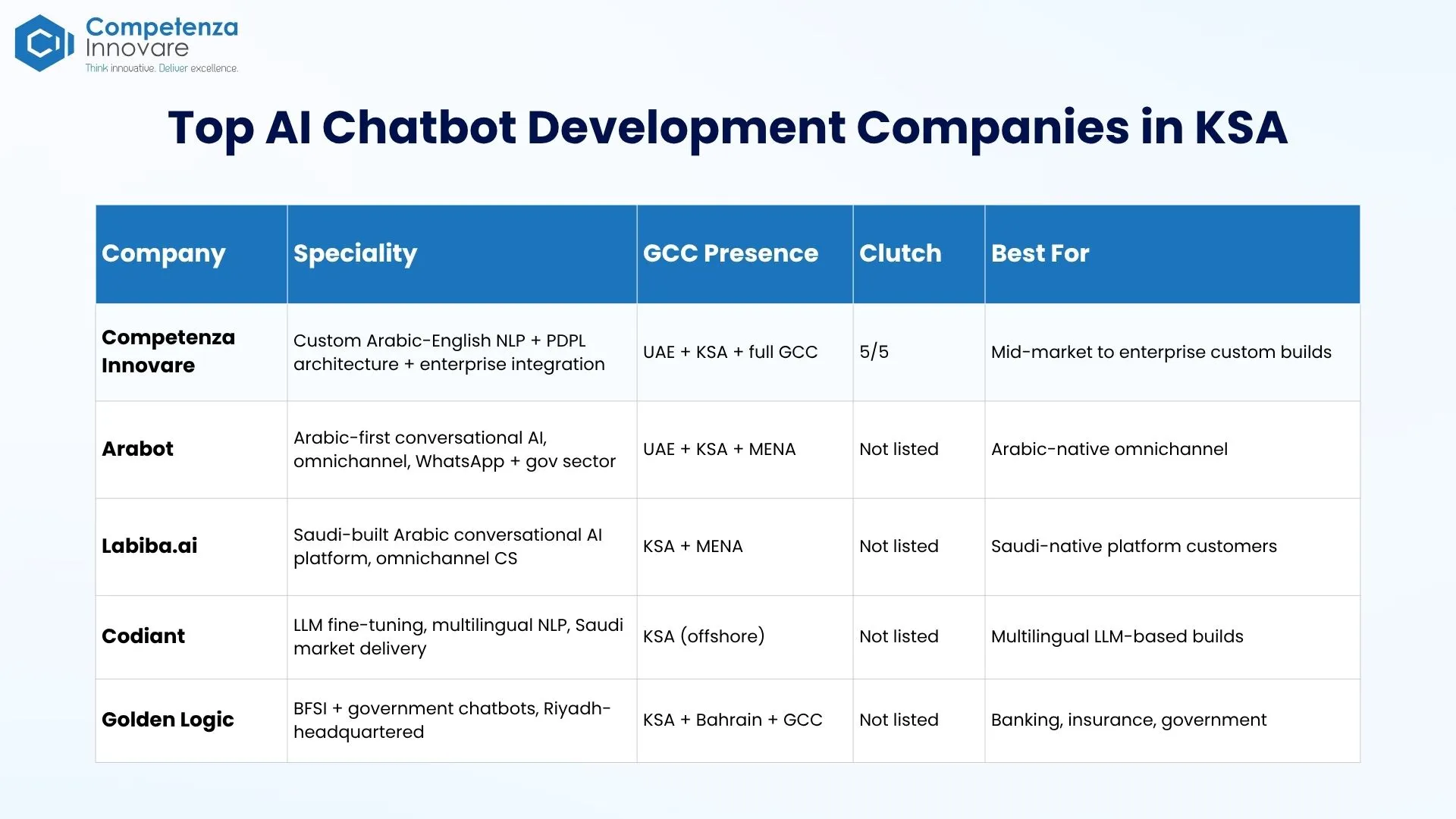
1. Competenza Innovare

Competenza is a custom software development and AI/ML delivery company with 10+ years of delivery experience across UAE and Saudi Arabia. They build AI chatbots from the ground up rather than reselling platform licences, which means the architecture is designed to fit the client’s compliance environment, integration stack, and Arabic language requirements from day one.
Their chatbot work sits within a broader AI/ML practice that includes LLM development, RAG implementation, process automation, and MLOps. Enterprise clients get a system built for production, not a demo-grade pilot.
What distinguishes Competenza in the Saudi market is the combination of bilingual Arabic-English NLP, PDPL and NCA-aligned data governance, and deep integration experience with enterprise CRM, ERP, and WhatsApp Business API. Their mobile app development capability extends chatbot functionality into native iOS and Android applications where required. Discovery, architecture, compliance review, build, and post-launch support are delivered under clear SLAs, which matters for CIOs managing deployment governance.
Their mobile app development capability extends chatbot functionality into native iOS and Android applications where required. Discovery, architecture, compliance review, build, and post-launch support are delivered under clear SLAs, which matters for CIOs managing deployment governance.
Strengths:
- Bilingual Arabic-English NLP chatbots built on LLM and RAG architectures, not translation layers. Relevant to AI adoption barriers in the Middle East that trip up global-first vendors
- PDPL and Saudi cloud-region data residency compliance engineered from architecture, not retrofitted post-launch
- WhatsApp Business API integration with Mada, STC Pay, Tabby, and enterprise CRM/ERP connectivity
- 5/5 on Clutch, ISO-certified delivery, 750+ organisations served across 20+ industries
- Delivery track record across AI and ML applications in healthcare, banking, retail, and logistics across the UAE and Saudi Arabia
Best for: Saudi and GCC enterprises requiring custom Arabic-English AI chatbots with PDPL-compliant architecture, enterprise system integration, and post-launch ownership
Considerations: Competenza is best suited for mid-market to enterprise custom builds. Not the right fit for off-the-shelf chatbot deployments or very early-stage MVP-only projects where speed over architecture is the priority.
Location: Dubai, UAE (active delivery in UAE and Saudi Arabia)
Clutch rating: 5/5
Team size: 150+ specialists
GCC presence: UAE + Saudi Arabia + wider GCC
2. Arabot

Arabot specializes in Arabic conversational AI and has delivered chatbot solutions for Aramex (logistics automation on WhatsApp) and the UAE Federal Authority for Government Human Resources. They also deployed a chatbot-based admissions interface for Batterjee Medical College in Jeddah. Their platform covers WhatsApp, Facebook Messenger, Instagram, and web channels, with agentic AI capabilities for multi-step process automation.
Strengths:
- Deep Arabic language focus with named regional deployments across UAE and KSA
- Omnichannel coverage including WhatsApp, Facebook, Instagram, and SMS
- Proven in government and logistics sectors with measurable operational automation
Best for: Arabic-first conversational AI with proven regional deployment across UAE and KSA
Considerations: Enterprise-level customisation and PDPL-specific compliance architecture may require additional scoping for complex Saudi enterprise deployments. Pricing might be too restrictive.
Location: Dubai, UAE (MENA delivery)
Clutch rating: Not publicly listed
Team size: Not disclosed
GCC presence: UAE + Saudi Arabia + wider MENA
3. Labiba.ai

Labiba.ai is a Saudi-based company focused on Arabic AI chatbots and intelligent automation, with specific positioning around omnichannel customer service in KSA. Their platform supports Arabic NLP for customer interactions and is oriented toward Saudi enterprises looking for a regionally built solution with local support.
Strengths:
- Saudi-headquartered with direct KSA market knowledge and regulatory familiarity
- Arabic language focus with omnichannel platform capabilities
- Strong positioning for customer service and support automation in the Saudi market
Best for: Saudi enterprises seeking a dedicated Arabic conversational AI platform with omnichannel customer service support
Considerations: As a platform-based provider, deep enterprise customisation may be limited compared to custom build partners. Publicly available outcome metrics are limited.
Location: Riyadh, Saudi Arabia
Clutch rating: Not publicly listed
Team size: Not disclosed
GCC presence: KSA and MENA
4. Codiant

Codiant positions itself as an AI chatbot development company serving the Saudi market, with stated capabilities in LLM fine-tuning (GPT-4, Claude), multilingual Arabic-English NLP, and generative AI for customer engagement. Their service catalogue includes AI chatbot development, RAG-based assistants, and computer vision, covering healthcare, fintech, and retail.
Strengths:
- LLM fine-tuning experience with multilingual and cultural accuracy focus
- Broad AI service catalogue spanning chatbots, automation, and AI app development
- Stated Saudi market orientation with industry-specific healthcare and fintech focus
Best for: Mid-scale enterprises needing multilingual chatbots with LLM fine-tuning and Saudi market delivery
Considerations: Based offshore. Data residency for Saudi PDPL compliance and in-Kingdom support SLAs should be confirmed before committing.
Location: India (Saudi Arabia and GCC delivery)
Clutch rating: Not publicly listed in KSA context
Team size: 250+ (estimated)
GCC presence: Saudi Arabia delivery (remote)
5. Golden Logic

Golden Logic is a Riyadh-headquartered technology company with an established track record across BFSI, government, healthcare, and real estate in Saudi Arabia. Their AI portfolio includes chatbot development, VR/AR, security consulting, and enterprise application development, with stated support for BFSI use cases including online account opening and smart shopper applications.
Strengths:
- Physically headquartered in Riyadh with deep BFSI sector knowledge
- Broad technology portfolio covering chatbots, enterprise apps, and security consultation
- Established GCC delivery across Saudi Arabia, Bahrain, and regional clients
Best for: Golden Logic is best for Saudi banking, insurance, and government organisations seeking AI chatbots with a local Riyadh presence.
Considerations: Arabic NLP depth and specific chatbot outcome metrics are not prominently documented in available public materials.
Location: Riyadh, Saudi Arabia
Clutch rating: Not publicly listed
Team size: Not disclosed
GCC presence: KSA, Bahrain, and wider GCC

What to Look for in an AI Chatbot Partner: Enterprise Buyer's Checklist
Most vendors will say they support Arabic and comply with PDPL. That alone doesn’t prove they can deliver in Saudi Arabia. The real difference shows up in how their systems handle local language, regulations, integrations, and post-launch reliability.
The six criteria below help you separate vendors with proven KSA deployments from those still positioning for the market. These are the same filters used in our broader evaluation of AI adoption across the Middle East.
KSA AI chatbot vendor evaluation: six criteria at a glance

1. Arabic NLP depth, not just translation
Ask whether the Arabic NLP model was trained on Gulf Arabic datasets or whether it uses an English-first model with Arabic translation. The former handles dialect variation and morphological complexity. The latter fails in real Saudi customer language.
2. PDPL and NCA compliance architecture
Saudi PDPL requires a lawful basis for data collection, explicit consent mechanisms, and data residency aligned to national requirements. Enterprises in banking need SAMA compliance, healthcare-adjacent deployments need SFDA alignment. Ask the vendor to walk you through how these are handled in the architecture.
3. WhatsApp Business API integration with Saudi payment support
WhatsApp is the dominant customer channel in KSA. Confirm WhatsApp API delivery and ask specifically about Mada, STC Pay, and Tabby payment gateway support if your use case involves commerce or appointment booking.
4. Verified case studies with measurable outcomes
A vendor who has deployed a chatbot that reduced support ticket volume by 40% or achieved 70%+ query resolution without human escalation has done the hard work. Vendors who cannot provide outcome metrics for at least one Saudi or GCC deployment have not yet earned the reference.
5. Enterprise integration credentials
Chatbots that cannot connect to your CRM, ERP, or appointment management system are screen-layer solutions. Confirm the vendor has delivered integrations with the systems you operate. This is especially relevant for AI-powered mobile applications in the GCC where the chatbot must surface in the app, not just on the web.
6. Post-launch support in Saudi time zones with clear SLAs
A chatbot that degrades after six months without model retraining, or fails during peak load events like Ramadan or National Day campaigns, is a business risk. Confirm support SLAs, escalation paths, and whether the account team is in-region or remote-managed.
The Competenza Approach to AI Chatbot Development
At Competenza, we have delivered AI chatbots and conversational AI systems for enterprises across Saudi Arabia’s digital transformation programmes, healthcare, and financial services. What we consistently find is that the gap between a chatbot that performs in a demo and one that holds up in production comes down to three things:
- Arabic NLP trained on Gulf dialect data,
- PDPL and NCA compliance are designed into the architecture, and
- Integration depth that connects the chatbot to the systems that matter.
Our chatbot development practice sits within our AI/ML solutions capability, meaning every chatbot we build is underpinned by MLOps, intent classification valid
The custom software development delivery model means we scope compliance and integration architecture before a line of code is written.
For healthcare organisations considering chatbot deployment, our piece on AI and machine learning transforming healthcare in the GCC covers the NPHIES, SFDA, and DHA integration considerations specific to patient-facing AI systems. For organisations with mobile-first strategies, our guide to AI in mobile app development shows how conversational AI integrates into native applications.
If your project requires bilingual Arabic-English NLP, WhatsApp Business API integration, PDPL-compliant data governance, or enterprise CRM connectivity for the Saudi market, Competenza’s delivery record across the UAE and KSA makes us a strong first call.
Get a GCC Chatbot Development Assessment: competenza.ae/custom-software-development. We respond within one business day.
Conclusion
Saudi Arabia declared 2026 the Year of AI. That is not a branding exercise — it is a procurement signal. Banks, healthcare providers, and retailers are moving simultaneously. The organisations that define their chatbot infrastructure this year will own the customer experience benchmark that their competitors spend the next three years trying to match.
The gap between a chatbot that performs in a demo and one that holds up in a Ramadan peak-load event or a PDPL compliance audit is not a technology gap. It is a decision gap. It comes down to whether you choose a vendor who built for the Saudi market or one who adapted a global product and called it localised.
You now have the criteria. You know the questions that separate vendors who have delivered in KSA from those positioning for it.
The next step is not another comparison. It is a scoping conversation.
Bring your integration requirements, your compliance constraints, and your channel priorities. The enterprises moving now are not moving fast for the sake of it — they are moving because the cost of a second deployment to fix the first one is significantly higher than getting the architecture right from the start.
FAQs
How much does AI chatbot development cost in Saudi Arabia?
Cost depends on architecture complexity, Arabic NLP requirements, integration depth, and compliance scope. A basic rule-based chatbot typically starts from SAR 30,000–50,000. An enterprise AI chatbot with Gulf Arabic NLP, LLM-based intent recognition, PDPL-compliant data governance, WhatsApp Business API integration, and CRM connectivity typically starts from SAR 75,000 and can reach SAR 300,000+ for full multi-system enterprise deployments. Arabic NLP model training, Saudi cloud-region data residency, and SAMA or SFDA compliance requirements each add material cost and engineering effort. For a broader cost framework, see our guide to AI use cases and investment signals for GCC businesses.
Can AI chatbots handle Arabic and Saudi dialects?
Yes, but quality varies significantly. AI chatbots trained on Gulf Arabic datasets can handle Modern Standard Arabic, Najdi dialect, Hijazi Arabic, and Arabizi with 85–95% intent recognition accuracy. Chatbots applying Arabic translation layers to English-first models perform significantly worse on real Saudi customer language. When evaluating vendors, ask specifically whether their Arabic NLP is trained on Gulf dialect data or relies on translation from MSA or English base models.
What is the difference between rule-based and AI-powered chatbots?
Rule-based chatbots follow predefined decision trees and respond only to exact keyword matches. They break when conversations go off-script and cannot learn from user interactions. AI-powered chatbots use NLP and machine learning to interpret intent, handle unstructured input, manage multi-turn conversations, and improve from usage data. Hybrid architectures combine both: rule-based logic for structured flows such as payment processing, and AI for open-ended customer queries. Enterprise deployments in Saudi Arabia typically require hybrid or full AI architectures to handle Arabic dialect variation.
How long does it take to build an enterprise chatbot for KSA?
Basic single-channel implementations typically deploy in 6–8 weeks. Enterprise chatbots requiring Gulf Arabic NLP model training, PDPL compliance architecture, WhatsApp Business API integration, and CRM connectivity typically take 3–6 months from discovery to production launch. For more on implementation planning, see our AI adoption barriers and roadmap guide for the Middle East.
Is WhatsApp chatbot integration available for Saudi businesses?
Yes. WhatsApp Business API integration is standard in enterprise AI chatbot development for KSA. Saudi businesses must comply with PDPL data processing requirements and obtain lawful user consent for WhatsApp communications. Marketing templates require Meta approval before broadcast deployment. A hybrid architecture is recommended for LLM-based deployments: the AI processes intent in backend services, and WhatsApp delivers compliant outputs. For a broader context on AI-enabled mobile application development in the region, see our piece on AI in mobile app development for GCC enterprises.