At a glance
Artificial intelligence and machine learning are no longer one-off pilot experiments in Gulf healthcare. Across hospitals in the UAE, KSA, and Qatar, executives are leveraging the specialized artificial intelligence solutions GCC markets have to offer to solve visible pressure points, such as clinician shortages, manual claim errors, and compliance complexity. This shift represents a move from experimental technology to essential infrastructure.
In this article, we explore:
Why AI/ML adoption is accelerating in GCC healthcare, and how local regulations such as DHA, ADHICS, NCA (and SAMA in KSA) shape deployment models and data strategies. Strategic imperatives for CIOs and CMIOs – how to align AI and machine learning in healthcare initiatives with national health transformation programmes such as Saudi Vision 2030 and the UAE Digital Government Strategy.
High-impact AI use cases in Healthcare are already reshaping care delivery, from diagnostic imaging to claims automation.
Regional data and deployment challenges, including data residency, privacy, and the shortage of specialised AI and data-science talent.
Measurable outcomes including faster triage, lower administrative costs, better utilisation of clinical resources, and improved patient satisfaction., Competenza.ae’s approach, combining local compliance expertise with scalable AI/ML delivery for regulated healthcare environments.
By the end, readers will see how a region-aware delivery approach helps GCC healthcare providers move from isolated AI experiments to sustainable, compliant transformation, one measurable metric at a time.
Introduction
Hospitals and clinics across the Gulf are facing continuous challenges from growing patient volumes, tightening budgets, and limited specialist availability.
Earlier, what used to be manageable through incremental staffing or new software has now hit a ceiling. That’s the reason AI in healthcare is gradually becoming an operational necessity.
In the United Arab Emirates, Saudi Arabia, and Qatar, health authorities are backing national AI programmes that tie technology investment to measurable healthcare outcomes. Following the latest GCC healthcare AI news in Dubai, such as the launch of the region’s first AI-powered MRI at Reem Hospital and the introduction of “Agentic AI” assistants for medical university admissions, it is clear that the region is shifting from experimental pilots to a hyper-intelligent clinical infrastructure.
For example, the UAE Strategy for Artificial Intelligence 2031 positions AI as a core enabler of public health quality and predictive analytics. Similarly, Saudi Vision 2030’s Health Sector Transformation Programme lists AI-based triage and data management as central pillars for improving the efficiency of care delivery.
What makes this transformation distinctive is its local context. GCC healthcare providers are not adopting AI for novelty. They are pursuing it to solve direct operational problems like overworked clinicians, slow diagnostic cycles, and growing compliance requirements around patient data. AI is becoming the mechanism that keeps compliance, cost, and care quality in balance.
Here’s what that looks like in practice:
- Radiology teams are using AI to reduce report turnaround time
- Claims departments are automating form validation and coding.
- Hospital administrators are analyzing staffing patterns against clinical throughput.
Though the value of artificial intelligence in healthcare comes from focused, high-impact use cases rather than blanket automation.
It is vital to ensure specific high-impact tasks are being performed faster and more accurately than human teams can sustain manually.
Why GCC Healthcare Leaders Are Turning to AI and ML
Across Gulf hospitals, Artificial intelligence and machine learning are no longer viewed as experiments. They have become the operational backbone of how healthcare leaders are rethinking performance metrics, compliance tracking, and patient care quality.
Lately, executives in the United Arab Emirates and Saudi Arabia have realized that ambitious national health visions, expanding patient volumes, and staff limitations can’t be solved by traditional hiring.
AI in healthcare helps fill skill gaps, strengthens compliance, and enables healthcare providers to improve service quality without increasing costs at the same pace.
In many facilities, Artificial Intelligence is now embedded at two levels, clinical and administrative. Clinically, AI and ML models are trained on local datasets and support diagnostics, imaging, and triage workflows.
The benefits of AI in healthcare are not just limited to efficiency. GCC healthcare providers are starting to tie AI projects directly to national transformation frameworks like Saudi Vision 2030, UAE Centennial 2071, and local health data management regulations such as DHA, ADHICS, and NCA.
These programmes define clear expectations: build digital healthcare that is data-resident, compliant, and measurable in outcome.
When properly governed, AI offers healthcare leaders measurable clarity on three fronts:
Operational performance: Machine learning insights highlight workflow bottlenecks, which on resolution, enable better staffing and scheduling decisions.
Automated audit: Trails reduce the manual burden of proving data integrity under DHA or ADHICS audits.
Financial transparency: AI systems identify & flag billing inconsistencies early, reducing claim rejection rates and accelerating revenue cycles.
Let’s explore the high-impact use cases of AI and ML in healthcare.
High-Impact Use Cases of AI and Machine Learning in Healthcare
From the many pilot projects GCC hospitals undertake, only a few translate into measurable AI healthcare results. Success often depends on choosing the right use cases.
Below are four focus areas where AI applications in healthcare are already being used for getting results:
Diagnostics and Imaging (Radiology, Pathology, Screening)
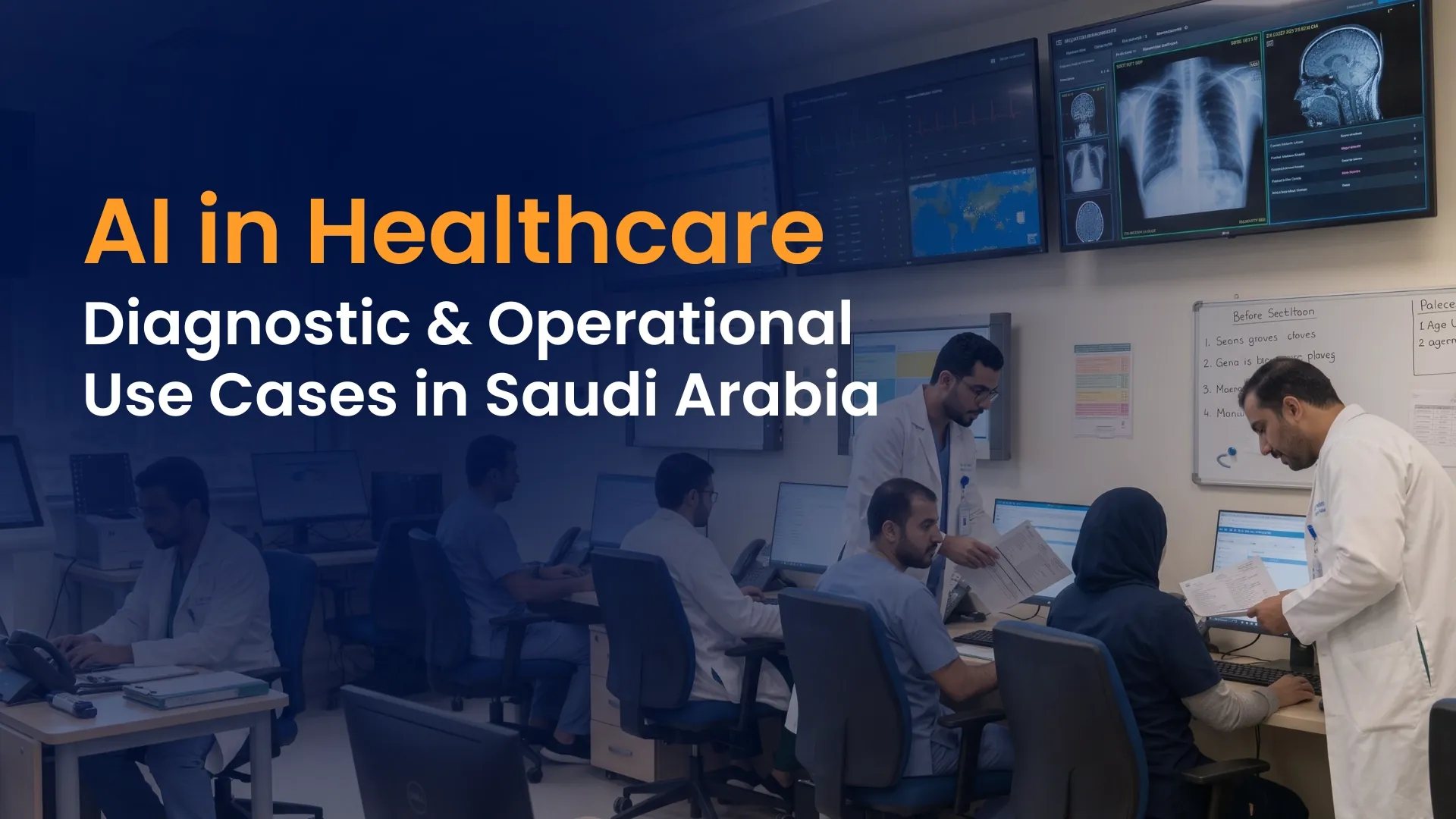
Radiology and pathology departments across the UAE and Saudi Arabia can fill the skill gap without proportional staff expansion. Machine learning models now read X-rays, CT scans, and histopathology slides to prioritize urgent findings and reduce turnaround time.
For example, in one KSA pilot, AI-assisted radiology reporting flagged critical abnormalities up to 60% faster than manual reviews. That improves triage outcomes while maintaining accuracy (World Health Organisation, 2024[https://www.who.int/news/item/10-06-2024-ai-in-diagnostic-imaging]).
Beyond simply increasing speed and filling critical skill gaps, hospitals utilizing AI-driven screening tools report a significant reduction in false negatives, leading to fewer missed early detections. This shift toward precision diagnostics is a primary catalyst for the GCC computer vision healthcare market, as regional providers invest in advanced imaging software to enhance clinical outcomes in oncology, radiology, and ophthalmology.
In the UAE, health authorities are adopting AI in national screening programmes for breast and lung cancer. These systems are designed to comply with ADHICS data residency and patient consent rules, which keep sensitive image datasets inside national data centres.
Thus, the advantage of AI in healthcare here is not just speed. It’s the precision to process large imaging workloads consistently. This allows radiologists to focus on critical clinical discussions rather than repetitive pattern recognition.
Remote Monitoring, Wearables, and Telehealth
Chronic disease management is a sector where AI and machine learning in healthcare can have the most direct patient impact.
Remote monitoring platforms powered by AI algorithms analyze continuous data from wearables and flag anomalies that require your attention.
A typical GCC deployment scenario for AI-powered remote monitoring involves diabetic or cardiac patients using connected devices that feed real-time vitals into an analytics dashboard.
AI models detect deviations in blood glucose or heart rate and alert healthcare providers before serious escalation.
For GCC healthcare providers, this use case also aligns closely with public health goals under Saudi Vision 2030 and the UAE Digital Government Strategy.
Both programmes encourage early intervention and personalized patient care through technology, provided that patient data remains stored securely within approved regional infrastructures.
Administrative Workflow Automation and Claims Processing
Every patient visit comes with a vast administrative engine for forms, coding, authorizations, and compliance logs.
Many GCC healthcare institutions still handle these manually, which is tedious. AI in healthcare is changing this reality.
AI-powered workflow automation tools extract data from scanned documents, categorise them by case type, and check claims for completeness before submission
This shortens billing cycles and reduces rejection rates, especially in insurer-linked hospitals.
These systems can be programmed to follow DHA and NCA rules automatically. This helps create digital audit trails that meet healthcare regulator expectations in the UAE and KSA.
Drug Discovery and Clinical-Trial Acceleration
AI’s contribution to pharmaceutical research and clinical validation is becoming central to the Gulf’s expanding healthcare R&D sector.
National biotech hubs in Abu Dhabi and Riyadh are already experimenting with applications of AI in healthcare to shorten discovery timelines and improve trial precision.
Machine learning models can identify molecular targets faster, simulate drug interactions, and predict trial outcomes before physical testing begins.
These capabilities reduce the time from concept to approval, an important advantage in regions investing in localized pharmaceutical manufacturing.
(Nature Medicine, 2024 [https://www.nature.com/articles/ai-drug-discovery-2024] reported that AI-supported compound screening reduced average pre-clinical research time by 40% across several global studies.
In the GCC, regulatory agencies like SFDA and MOHAP are now drafting frameworks to govern AI-driven research data usage and patient consent.
Even though these use cases look promising, they come with specific challenges. Let’s see what these challenges are.
Overcoming Strategic Challenges
Though applications of AI in healthcare across the GCC are very promising, translating pilots into long-term operations is challenging and requires tactful handling. Specifically, when implementing AI in healthcare UAE hospitals and health authorities are facing critical hurdles such as data control, deployment models, ecosystem integration, and talent availability. Addressing these gaps is essential for moving beyond experimental phases into sustainable, region-wide clinical adoption.
Your ability to address these challenges defines whether AI and machine learning will be experimental or embedded in the system. Let’s see how you can address these challenges strategically.
Data Strategy: Local vs Global Data, Privacy, and Residency
When it comes to a Gulf healthcare system, data residency is vital. The frameworks like DHA, ADHICS, and NCA ensure patients’ information remains within approved local data centres.
That means the project must start with data classification and localisation.
(According to IDC, 2024 [https://www.idc.com/getdoc.jsp?containerId=META50473324], 71% of GCC healthcare providers identified data sovereignty as their top constraint to scaling AI systems.)
In the UAE, health authorities have issued specific guidance requiring that AI algorithms used in diagnostic or triage systems must source and process data inside national boundaries.
In KSA, the National Cybersecurity Authority extends similar controls through the Cloud Computing Regulatory Framework (CCRF).
This localization mandate reshapes how you design your applications of AI in healthcare architecture, security-first, region-compliant, and auditable.
Model Development and Deployment
Once data governance is in place, the next decision is architectural. Should AI models run on local hospital servers or central cloud environments?
Both approaches carry trade-offs. Edge deployment, running models directly within hospital networks, offers stronger control and faster response times for real-time diagnostics or telehealth monitoring, but demands more investment in local infrastructure and maintenance talent.
On the other hand, Cloud deployment provides flexibility and scalability, but introduces potential compliance risk if patient care data leaves the jurisdiction.
The solution? Choose a hybrid model.
For GCC providers, hybrid remains the most pragmatic route. It helps you balance regulatory security with the processing power needed for imaging, predictive analytics, and administrative automation.
The key is ensuring AI applications in healthcare can move between on-premise and cloud environments without breaching residency or audit rules.
Integration with Existing Healthcare Ecosystems
Most regional hospitals already run multiple core systems, electronic health record systems (EHRs), laboratory information systems (LIS), and radiology platforms (PACS/RIS).
The difficulty is that these systems rarely communicate cleanly.
Introducing AI in healthcare into this environment requires careful mapping of data flows, APIs, and governance boundaries.
Without integration, AI insights remain siloed, and clinical staff end up juggling multiple dashboards.
The solution often lies in building lightweight middleware layers or API gateways that connect AI engines with operational platforms.
Competenza’s regional delivery experience shows that the more contextually aligned the integration plan is, especially with ADHICS and DHA interoperability standards, the smoother the deployment becomes.
Integration also impacts adoption. When clinicians can access AI recommendations directly within their workflow tools, trust in the system grows. Conversely, disjointed implementations tend to stall once pilots end.
Talent and Vendor Strategy
Human capacity is the most underestimated challenge in AI and machine learning in healthcare. GCC hospitals often lack in-house data science teams fluent in local compliance frameworks. Hiring or training such specialists takes time, while pressure for visible ROI keeps rising.
This tension is leading many health executives to adopt a hybrid talent model where they can retain core AI oversight internally while choosing to partner with region-aware solution providers for model development and managed operations.
(EY, 2023 [https://www.ey.com/en_gl/health/how-to-build-ai-healthcare-teams]) found that 64% of healthcare CIOs globally prefer co-delivery partnerships rather than full outsourcing to maintain compliance control and institutional learning.)
For GCC institutions, vendor selection carries both technical and regulatory weight.
A capable partner should understand SAMA, NCA, and ADHICS mandates as deeply as machine learning frameworks themselves.
Without this dual fluency, even a technically sound model can fail a compliance audit.
Between “build” and “partner” strategies, you should choose phased partnerships, starting with co-developed pilots, then transitioning ownership once internal teams mature.
This structure protects governance integrity while building long-term AI literacy inside the organization.
The path from AI exploration to institutional adoption requires managing four interlocking pieces: localised data strategy, deployment architecture, integration discipline, and a balanced talent ecosystem.
When these align, AI in healthcare shifts from a promising initiative to a sustained operational pillar, one that GCC hospitals can scale confidently within their national compliance frameworks.
Measuring Success
For GCC healthcare providers, the conversation around AI in healthcare has shifted from “what can it do” to “what does it prove.
Measuring success means tying AI outcomes directly to financial, operational, and clinical metrics, not just model accuracy or technical performance.
CIOs and COOs now assess their AI and machine learning in healthcare investments through the same lens as any other business initiative: efficiency, cost, and patient outcomes.
Let’s see in detail.
Operational Efficiency and Staff Productivity
Hospitals and clinics in the United Arab Emirates and Saudi Arabia have seen measurable workflow improvements by applying AI applications in healthcare administrative and diagnostic routines.
In radiology, AI-driven triage and image pre-reading systems shorten turnaround times and allow specialists to prioritize critical cases.
(According to Philips Future Health Index, 2024 [https://www.philips.com/a-w/about/news/archive/standard/news/press/2024/ai-in-healthcare.html]), Hospitals integrating AI-based diagnostic support achieved up to 19% faster report completion rates and reduced image backlog by 23%.
Operational metrics like patient throughput per clinician and case completion time per department now serve as leading indicators of success.
The more efficiently AI integrates into electronic health record systems, the more time clinicians can spend on direct patient care rather than on manual data entry or form validation.
Staff productivity gains are often immediate. AI-assisted documentation, scheduling, and billing workflows reduce administrative overhead, which frees hours each week for clinical work.
In regions where specialist shortages are severe, this shift directly influences patient access and satisfaction.
Financial Impact
Financial performance remains the most precise validation point for any AI used in healthcare.
GCC hospitals implementing AI-driven claims validation or automated coding systems report tangible cost savings within six to nine months of deployment.
Beyond direct savings, hospitals are discovering secondary financial benefits, fewer compliance penalties, optimised resource scheduling, and improved bed utilisation. Machine learning analytics also enable better forecasting of patient flow and consumable demand, lowering inventory waste.
When presented to governing boards, these outcomes demonstrate that artificial intelligence in healthcare is not an experimental expense anymore, but it is a driver of budgetary control.
Clinical Outcomes
While operational and financial metrics are easier to measure, clinical impact defines long-term credibility.
With AI-based analytics to track patient engagement, discharge follow-ups, and chronic conditions, GCC hospitals observed notable improvements in satisfaction and safety indicators.
In real GCC deployments, this translates to shorter waiting times, more consistent communication, and fewer post-discharge complications.
AI’s predictive models also flag patients at higher risk of readmission, which allows intervention teams to act earlier, a direct win for both clinical quality and cost control.
Hospitals that integrate these insights into their AI in healthcare dashboards can benchmark outcomes quarterly, providing compliance value alongside care quality.
For example, Several UAE-based health systems now treat AI-generated reports as official audit evidence in board reviews.
For example, a multi-hospital group adopted an AI-powered scheduling tool that balanced clinician rosters based on live case data.
Within six months, the operational throughput increased by 17%, and patient waiting times dropped by almost 30%.
This example tells one thing: success measurement works best when aligned with national reporting structures under DHA, NCA, and ADHICS. Metrics grounded in these frameworks resonate with regulators, auditors, and investors alike.
Future-Proofing Healthcare IT
The Gulf’s healthcare landscape is evolving faster than its infrastructure. CIOs and CMIOs across the United Arab Emirates, Saudi Arabia, and Qatar are now asking a more complex question: how to make today’s AI in healthcare investments relevant five years from now.
Future-proofing means treating AI not as a set of tools but as an adaptable layer of healthcare IT strategy, one that survives vendor changes, regulation updates, and shifts in patient demand.
Here’s how Competenza approaches that:

Competenza’s Approach
AI success in GCC healthcare depends on more than technology. It requires fluency in local regulation, practical deployment experience, and a results-driven delivery model.
Competenza combines these attributes through a model that is built for the Gulf, compliant by design, measurable by outcome, and aligned with both national and institutional health priorities.
Region-Aware Expertise
Across the GCC, healthcare compliance frameworks differ, but the rule stays constant: patient data must remain sovereign.
Competenza designs every AI in healthcare projects around that principle. From DHA and ADHICS in the UAE to NCA and SAMA in Saudi Arabia, deployments are built for local data residency and governance from day one.
We understand the daily realities of Gulf healthcare that covers insurer-linked billing, bilingual EHRs, and regulator audits, and translate that knowledge into faster approvals and smoother rollouts.
End-to-End Capability
At Competenza, we ensure the delivery model spans the full AI and machine learning in healthcare lifecycle from readiness assessment to managed operations.
We start by mapping compliant data sources and defining measurable business outcomes. Models are then built on local datasets and deployed in hybrid environments that balance scalability with compliance.
Integration with existing electronic health record systems keeps data flows auditable, while managed service teams monitor accuracy, cost, and uptime.
This end-to-end structure frees healthcare executives to focus on outcomes, efficiency, compliance, and patient experience — instead of managing multiple vendors.
Outcome-Focused Engagement
Competenza measures success by what each AI solution delivers, not by how advanced it sounds. Every engagement defines KPIs across clinical, operational, and compliance domains before a single model is trained.
Projects follow a simple rhythm — assess, pilot, scale — giving executives measurable progress and complete audit visibility.
The result is a grounded, performance-first approach. Competenza.ae doesn’t just deploy AI; it embeds accountability — guiding healthcare organizations from exploration to proven, compliant impact.
Ready to regain control? Request a Competenza vendor lock-in audit to assess your app’s independence.

Own your code, your uptime, and your future.
Conclusion
Across the GCC healthcare sector, AI has moved beyond theory. Hospitals in the UAE, Saudi Arabia, and Qatar are already proving that when designed for local compliance, AI and machine learning in healthcare can solve long-standing issues, from radiology backlogs to claim bottlenecks. In particular, the rapid scaling of AI and machine learning in healthcare in UAE facilities demonstrates how national rails like the “EHS Intelligence” program can strengthen patient safety and data governance while setting a new global standard for digital health.
The journey, however, isn’t about deploying algorithms for the sake of innovation. It’s about creating measurable transformation. That means selecting use cases that address operational pain points, building data architectures that honour residency laws, and partnering with teams who understand both healthcare and regulation.
Executives now face a clear opportunity. Those who assess their readiness, strategize around the right AI priorities, and partner with region-aware experts will define the next era of healthcare competitiveness in the Gulf. Others may find themselves constrained by legacy systems and regulatory friction.
Competenza stands at that intersection that combines compliance fluency, technical execution, and measurable outcomes. For GCC healthcare leaders seeking clarity and momentum in their AI journey, now is the moment to act.
FAQs
How are GCC hospitals actually using AI right now?
Most hospitals in the UAE and Saudi Arabia are using AI in healthcare for radiology triage, claims validation, and patient data analytics. The focus isn’t on experimental projects; it’s on reducing workload, improving accuracy, and keeping compliance with DHA, NCA, and ADHICS rules.
What's driving AI adoption in healthcare across the Gulf?
Workforce shortages, compliance pressure, and data fragmentation. When radiologists are handling double their usual case volumes or admin teams are spending hours on manual claim entries, AI and machine learning in healthcare become practical, not optional.
What's the best place to start if our hospital has never used AI before?
Start small but measurable. Most healthcare providers begin with applications of AI in healthcare areas like claims automation or imaging report prioritization. These use cases deliver quick ROI and prove value before scaling into more complex workflows.
How does Competenza ensure AI deployments meet GCC compliance standards?
Compliance isn’t an afterthought — it’s the design foundation. Every deployment aligns with national frameworks such as DHA (UAE), ADHICS (Abu Dhabi), NCA (KSA), and SAMA (Saudi Central Bank). Data residency, encryption, and audit reporting are built into the project from the start.
What's the most prominent mistake healthcare organizations make with AI projects?
Jumping straight to model building without defining clear outcomes or governance. AI only succeeds when tied to measurable metrics — cost reduction, clinical accuracy, or compliance visibility. That’s why Competenza sets KPIs before any technical development begins.