Updated October 2026. Reviewed by Competenza’s healthcare delivery team.
Who this is for: clinic owners, pharmacy and hospital-group leaders, and health-tech founders in Saudi Arabia deciding where to start with AI.
TL;DR
- AI in healthcare in Saudi Arabia is live in screening and workflow tools, but wide hospital deployment is still rare.
- Diagnostic AI needs SFDA marketing authorization; operational AI mostly runs into PDPL and NPHIES requirements instead.
- Small clinics should start with one operational module; hospital groups can add claims checks and capacity forecasting.
- Buy an SFDA-authorised diagnostic tool before considering a custom clinical model.
- Budget anchor: single AI modules run SAR 10,000 to 60,000; custom AI platforms start around AED 150,000.
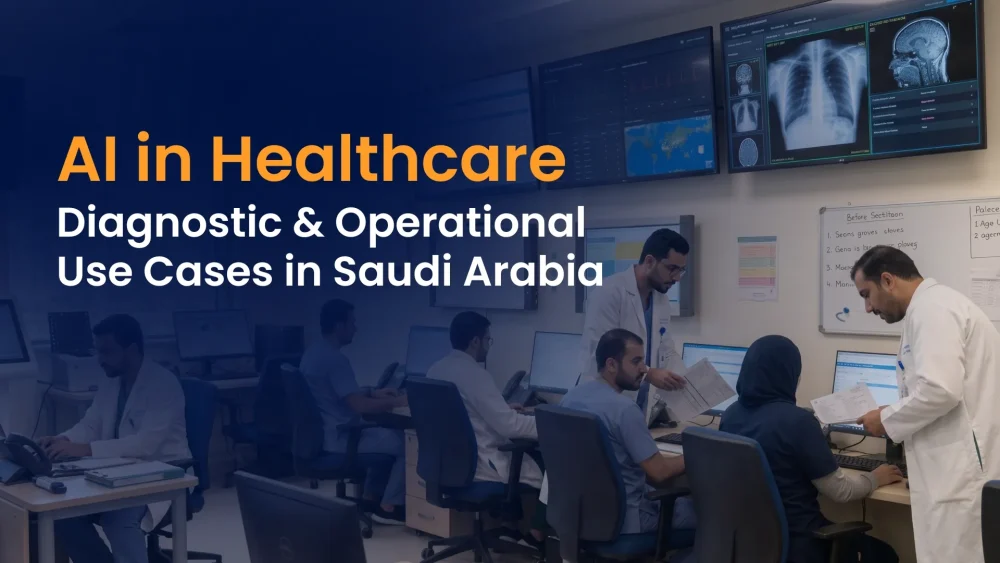
AI in healthcare in Saudi Arabia today does two jobs: diagnostic tools read images and clinical data, and operational tools run scheduling, claims and patient flow. Most providers should start with the second and buy the first. A 2025 review of 34 major Saudi hospitals found that only 5.88% had a dedicated AI centre and 8.82% had put AI into patient care, using data from 2023. Almost nobody has done either at scale.
That leaves you pitched on everything and shown proof for very little. Teams buy a diagnostic pilot before their booking and consent data can feed it. Others commission a model that needs SFDA marketing authorization nobody budgeted for. Some point a foreign-hosted AI at patient records and walk into the PDPL’s transfer rules.
Here is what most guides miss: the two kinds of AI follow different rulebooks, budgets and timelines. Below you get what is live in the Kingdom, what the SFDA, SDAIA, NPHIES and PDPL require, and a five-question test for picking your first project.
How much AI is actually running in Saudi healthcare?
Less than the headlines suggest. Regulators frame their AI approvals as part of the Health Sector Transformation Program under Vision 2030, and SDAIA supervises both the national AI strategy and the PDPL. Policy is ahead of deployment.
In the Bayer and Eisawi review, two of 34 major hospitals had dedicated AI centres and roughly three had implemented AI in patient care. The study worked from public websites and social media, so it likely undercounts quiet deployments. The direction is still clear.
The causes are practical. Argaam’s analysis says hospital AI tends to stall on who pays for an uncertain build-out and the governance around it. A 2025 systematic review adds that skills gaps and infrastructure investment slow uptake.
Which diagnostic AI use cases are live in Saudi Arabia?
Diagnostic AI in Saudi Arabia works as decision support, and the authorisations show it. Two kinds of AI diagnostics are running in KSA: screening tools with SFDA authorization, and one supervised pilot.
The clearest example is SAARIA. The SFDA authorised SAARIA and Dental IQ, two Saudi-developed AI tools. SAARIA analyses retinal images to support screening of diabetic patients for retinopathy. Both products came through the SFDA’s Innovative Medical Devices Pathway, which gives early regulatory guidance.
The need is real. Arab News has reported that only an estimated 24 percent of patients had been screened for diabetic eye disease. SAARIA’s developer, SDM, says the tool has screened more than 70,000 diabetic patients, a company-reported figure.
The pilot is Dr. Hua. In April 2025, Synyi AI and Almoosa Health Group opened an AI clinic in Al-Ahsa. The system covers about 30 respiratory conditions, and a licensed doctor reviews every treatment plan. Synyi reports an error rate below 0.3% from internal testing, but methodology and sample size were not disclosed.
Both cases keep a clinician in the loop. The SFDA itself cautions against relying solely on AI output for clinical decisions.
Ask any diagnostic AI vendor for proof of SFDA marketing authorization and the exact intended use it covers. If it has neither, treat the product as a pilot.
Which operational AI use cases pay back first in Saudi hospitals and clinics?
The ones that sit closest to your daily workflow. The rules are lighter and you can measure the result in weeks. Five are worth a look.
Patient flow and capacity. King Faisal Specialist Hospital uses operational intelligence to guide the patient journey from admission to discharge, according to its Center for Healthcare Intelligence. Argaam makes the economic case: hospital AI pays back by attacking capacity waste and revenue leakage using data you already collect.
Claims and eligibility checks. NPHIES, the national health insurance exchange, carries eligibility checks, pre-authorisation, claim submission and payment reconciliation. An AI step that catches missing fields before a claim goes out sits directly in front of that flow.
Booking, reminders and no-shows. A bilingual Arabic and English assistant on WhatsApp books, reschedules and reminds. An AI agent hands exceptions to front-desk staff.
Document and prescription intake. OCR reads prescriptions, referral letters and insurance cards, and flags unreadable fields for a person to confirm.
Pharmacy demand forecasting. Sales history and seasonality feed reorder points, which cuts stock-outs and expiry waste.
Competenza’s engineers work inside the workflows these tools plug into. On Apollo 24/7, the digital platform of India’s largest pharmacy network, the team worked on diagnostic booking, video consultation scheduling and prescription upload journeys, with 98.9% backend uptime during peak demand.
For a MENA telehealth operator, the team rebuilt scheduling, consent, billing and audit-friendly activity logs. Operational AI depends on those layers, and they belong in any healthcare software development scope.
Share your booking, claims or pharmacy process and we’ll point to the operational AI module with the fastest payback.
How do diagnostic and operational AI compare?
Your first choice sets the rulebook, the budget and the timeline.

Operational tools that influence clinical decisions can cross into device territory. Confirm classification with the SFDA or a regulatory advisor before launch.

What do SFDA, SDAIA, NPHIES and the PDPL require for healthcare AI in Saudi Arabia?
Treat the SFDA as the gatekeeper for diagnostics and the PDPL as the gatekeeper for everything.
SFDA. The MDS-G010 guidance sets the requirements for marketing authorization of AI and machine-learning medical devices, defined as tools that diagnose, manage or predict disease from medical data.
PDPL. Health data counts as sensitive personal data. Violations can bring fines up to SAR 5 million, doubled for repeat offences. One legal commentary adds that a breach must be reported to SDAIA within 72 hours, and that wiring a system to a foreign AI model API counts as a transfer outside the Kingdom.
NPHIES. Any AI tool that touches claims, eligibility or pre-authorization has to work with NPHIES transactions. It cannot run beside them.
NCA. The National Cybersecurity Authority’s Essential Cybersecurity Controls add a security baseline for Saudi-facing systems. Confirm which controls apply to your entity.
Map where each vendor’s servers and model APIs sit before you sign. A foreign-hosted model reading patient records is a data transfer, and it needs a lawful pathway under the PDPL’s transfer rules.
This is a summary, not legal advice.
Get a scoped estimate in SAR, with a phased roadmap and PDPL requirements mapped from day one.
What stops AI projects in Saudi hospitals from scaling?
Four things, and the algorithm is rarely one of them.
Funding the uncertain part. Build-out and governance cost money before they return any, and Argaam notes that public hospitals are reluctant to commit capital upfront.
Skills. Your clinicians and administrators need training to review AI output critically.
Foundations. AI needs consistent bookings, consent records and audit logs underneath it. Where those sit in separate systems, a model sees fragments of the patient journey.
Clinician trust. The SFDA’s caution and Synyi’s sign-off model point the same way. Design AI so staff review exceptions, and keep the final decision with a licensed clinician.
How should you choose your first AI use case?
Choose by risk first, then by payback. Run five questions against each candidate.
- Does it change a diagnosis or a treatment? If yes, device rules apply. Buy an authorised tool.
- Is the data already digital and clean enough to use?
- Who owns the metric the project must move?
- Where will patient data be hosted and processed, and does any of it leave the Kingdom?
- What is today’s baseline, so you can measure the change?
If you run a clinic or pharmacy chain: start with one operational module, such as Arabic and English WhatsApp booking or prescription intake. Competenza’s published range for a single module is SAR 10,000 to 60,000 in Saudi Arabia, with delivery in 4 to 8 weeks.
If you run a hospital group: add claims pre-checks and capacity forecasting once the first module proves out, and buy SFDA-authorised tools for diagnostics. Custom AI and ML platforms start from about AED 150,000, depending on integrations.
Unsure which module to pick? An AI readiness assessment for GCC businesses scores six dimensions before you commit budget.
FAQs
How is AI used in healthcare in Saudi Arabia?
AI in Saudi healthcare is used for screening and diagnostic support, such as the SFDA-authorised SAARIA retinal tool, and for operations such as patient flow, claims checks, booking and pharmacy forecasting. Most uses keep a clinician or staff member in the loop.
How many Saudi hospitals use AI?
A 2025 review of 34 major hospitals found 8.82% had implemented AI in patient care and 5.88% had a dedicated AI centre, using data from 2023. The count likely understates quieter deployments.
Does AI diagnostic software need SFDA approval?
Yes. Software that diagnoses, manages or predicts disease falls under the SFDA’s AI/ML medical device guidance (MDS-G010) and needs marketing authorization before it is sold in the Kingdom.
Can patient data be processed by AI hosted outside Saudi Arabia?
The PDPL restricts transfers outside the Kingdom to lawful pathways, and health data is sensitive. A risk assessment may be required for large-scale transfers. Check hosting and model APIs with legal counsel before launch.
How much does AI cost for a Saudi clinic or hospital?
A single AI module, such as WhatsApp booking or document intake, runs SAR 10,000 to 60,000. Custom AI-integrated platforms start from about AED 150,000. Final cost depends on integrations and scope, which a discovery assessment pins down.
Which AI use case should a small clinic start with?
Start with booking, reminders and intake. These usually sit outside device rules, use data the clinic already holds and show results within weeks. Confirm classification if the tool influences clinical decisions.
Do AI claims tools have to work with NPHIES?
Providers exchange eligibility checks, pre-authorisations and claims through NPHIES, so an AI tool that touches claim data has to fit those transactions.
How long does it take to launch a first AI module?
A single module typically takes 4 to 8 weeks from discovery to launch in Competenza’s delivery experience. Platforms with several integrations take longer.