TL;DR
- An MVP (minimum viable product) is the smallest version of a software product that real users can use, built to test a business assumption before you spend on the full build.
- An MVP is not a prototype and not a proof of concept. Those test whether something can be built. An MVP tests whether people want it.
- Most MVPs take 6 to 14 weeks to build, depending on platform count and feature scope.
- The process runs: validate the problem, scope the smallest useful version, pick a build approach, prototype the core flow, build and test, then set up a feedback loop.
- Founders most often go wrong by scoping too many features, adding AI before it is needed, or skipping the feedback loop after launch.
An MVP, or minimum viable product, is the smallest working version of a software product that solves one real problem well enough for early users to actually use it. It exists to answer one question before you spend real budget: will people use this, or won’t they?
That question matters more in practice than in theory. A founder who skips it usually finds out the hard way, six months and a full budget later, that the market did not want what they built.
MVP vs. Prototype vs. Proof of Concept
These three terms get used interchangeably, and that causes real confusion when a founder is briefing a development team.
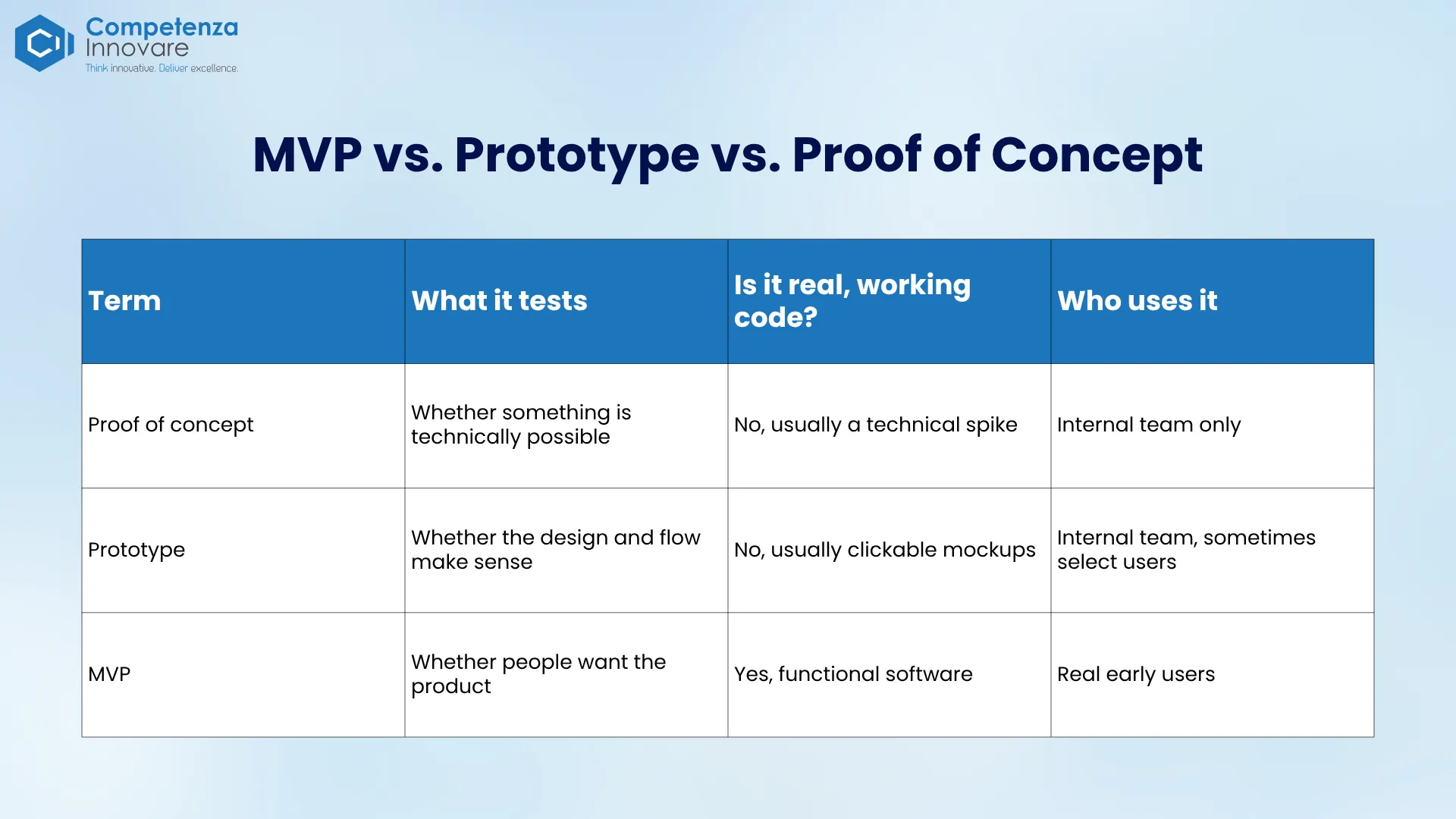
A proof of concept answers “can we build this.” A prototype answers “does this feel right.” An MVP is the only one of the three that puts working software in front of paying or signing-up customers.
Why Founders Build an MVP First
Building the full product before validating demand is the single most common way software budgets get wasted. An MVP exists to prevent that.
It forces a founder to decide what the product’s core value actually is, not what it could eventually become. It also produces something real: usage data, sign-ups, or paying customers, not opinions.
For a founder raising a seed round, a working MVP with real usage numbers is also a stronger fundraising asset than a pitch deck alone.
How MVPs Actually Get Built
The process is more disciplined than “build a small version and see what happens.” Here is what actually happens between the idea and the launch:
1. Validate the problem, not the idea
Before any code gets written, the real question is whether the problem is worth solving. Talk to 10 to 15 potential users. Ask what they currently do instead of your product, and what it costs them not to have a solution.
2. Scope the smallest useful version
List every feature you want, then cut it down to the one or two that deliver the core value. A booking app’s MVP does not need loyalty points or in-app chat. It needs a working calendar and a confirmed booking.
3. Choose the build approach
Some MVPs are best built with low-code tools, particularly for pure workflow or form-based products. Most MVPs with any real logic, integrations, or scale ambition need custom-coded software from day one, so the architecture does not need a rebuild once it works.
4. Prototype the core flow first
Before writing production code, map the two or three screens a user touches to get value. This catches confusing flows early, when fixing them costs a design change instead of a rewrite.
5. Build, test, and ship
Before writing production code, map the two or three screens a user touches to get value. This catches confusing flows early, when fixing them costs a design change instead of a rewrite.
6. Set up the feedback loop before launch, not after
Analytics, a simple way for users to report issues, and a plan for reviewing usage weekly should all exist before the MVP goes live. An MVP without a feedback loop is just a small product, not an MVP.
How Long Does It Take to Build an MVP?
Timelines vary with scope, but as a rough guide: a single-platform MVP with a handful of core screens usually takes 6 to 10 weeks. A two-platform MVP, iOS and Android, or web and mobile, with account logic and one or two integrations usually runs 10 to 14 weeks.
Anything quoted at 2 to 3 weeks is almost always a prototype, not a working MVP. Anything scoped past 16 weeks has usually stopped being an MVP and become a full first release.
Where AI Fits Into an MVP Build
Founders increasingly want AI in the MVP from day one, and sometimes that is the right call. Other times it adds engineering weight the MVP does not need yet.
The features that show up most often in early-stage MVPs are AI chatbots for customer support, AI document processing for OCR or data extraction, personalisation or recommendation logic, and basic AI analytics for flagging anomalies in usage data.
Each of these adds real scope. A chatbot needs a knowledge base and a fallback path to a human. Document processing needs an accuracy benchmark before it goes live, not just a demo that works on one sample file. Analytics needs enough usage data to be meaningful, which an MVP with a handful of early users rarely has yet.
The useful question before adding any AI feature is whether it needs to be in the MVP to test the core assumption, or whether the assumption can be validated with a simpler, rules-based version first. If a chatbot could be an FAQ page for now, that is a feature for version two, not the MVP.
Where GCC Founders Get This Wrong
A few patterns show up repeatedly with founders building their first MVP in the UAE and Saudi Arabia specifically:
Treating compliance as a later problem: Data residency and consent requirements under UAE and Saudi PDPL are far cheaper to build in from day one than to retrofit after launch, particularly if the product touches customer or health data.
Under-scoping Arabic: Founders often plan an English-first MVP and add Arabic later, then discover that right-to-left layout is a structural decision, not a translation task, and reworking it after launch is expensive.
Picking a build partner purely on speed: An MVP built fast on the wrong architecture usually needs a partial rebuild the moment it gets real traction, which costs more than building it properly the first time.
Competenza's View and Recent MVP Work
At Competenza, we scope MVPs the same way we scope enterprise builds, just smaller. Startup budgets do not mean skipping architecture decisions, they mean making the right ones early so the product does not need a rebuild the moment it finds traction. You can read more here: Explore how Competenza scopes MVP builds for GCC founders
One example: for Cold Summit, a cold storage real estate provider, we built a prototype and then an MVP of their cold storage management tool, a verified engagement on Clutch.
For us, GCC compliance and Arabic UX get scoped from day one on every MVP, not bolted on after launch.
The Bottom Line
An MVP is not a cheaper, smaller version of your full product idea. It is the fastest, cheapest way to find out if that idea is worth building at all. Get the scope right, get the feedback loop right, and the rest of the build gets easier to plan.
Explore Competenza’s custom software development for GCC startups
FAQs
Is an MVP the same as a beta version?
No. A beta is usually a near-final product tested for bugs before a wider release. An MVP is an intentionally minimal product used to test whether the idea has demand at all.
Do I need a developer to build an MVP, or can I use no-code tools?
For simple, form-based, or workflow products, no-code tools can validate an idea quickly. For anything with real business logic, integrations, or a scaling ambition, custom-coded software avoids a rebuild once the MVP proves out.
How much does an MVP cost to build?
Cost depends heavily on platform count, integrations, and compliance scope, and varies widely by region and vendor. A separate breakdown of MVP cost and timeline for GCC founders is coming next in this series.
What happens after the MVP launches?
The team reviews real usage data against the original assumption, then decides whether to iterate on the current build, pivot the approach, or move into full-scale development.
Does an MVP need AI to be competitive?
No. An MVP needs to prove the core value works. AI is worth adding when it is the feature being tested, not as a default add-on to look more advanced.