
Agentic AI is software that takes a goal, plans the steps, uses tools such as your CRM or accounting system to carry them out, and checks its own results with limited human supervision. Google Cloud frames it the same way, as AI built for autonomous decision-making and action rather than answering one prompt at a time. In April 2026, the UAE Cabinet announced a framework to move 50% of government sectors, services and operations to agentic AI within two years, which makes the term a planning question for private businesses too.
This guide explains what the technology does, where it works, where it breaks, and how to start without handing an AI the keys to your finance system.
Key takeaways
- Agentic AI plans and acts across tools to finish a goal. A chatbot answers a question and stops.
- The UAE government has set a two-year deadline for agentic AI across half of its services, so supplier and customer expectations will shift.
- The best first workflow is high-volume, rule-heavy and reversible, such as receipt matching or ticket triage.
- Permissions, audit logs and human approval gates decide whether an agent is safe, far more than the model does.
- A pilot should have one workflow, one owner and three measurable KPIs before any build starts.
What does agentic AI actually do?
An agentic system runs a loop. It receives a goal, breaks it into steps, acts through connected tools, checks what happened, and adjusts.
Let’s consider the example of an expense claim. A chatbot can explain your policy. An agent reads the receipt, pulls the merchant and VAT, matches it to a card transaction, flags the mismatch, and routes the exception to a finance manager.
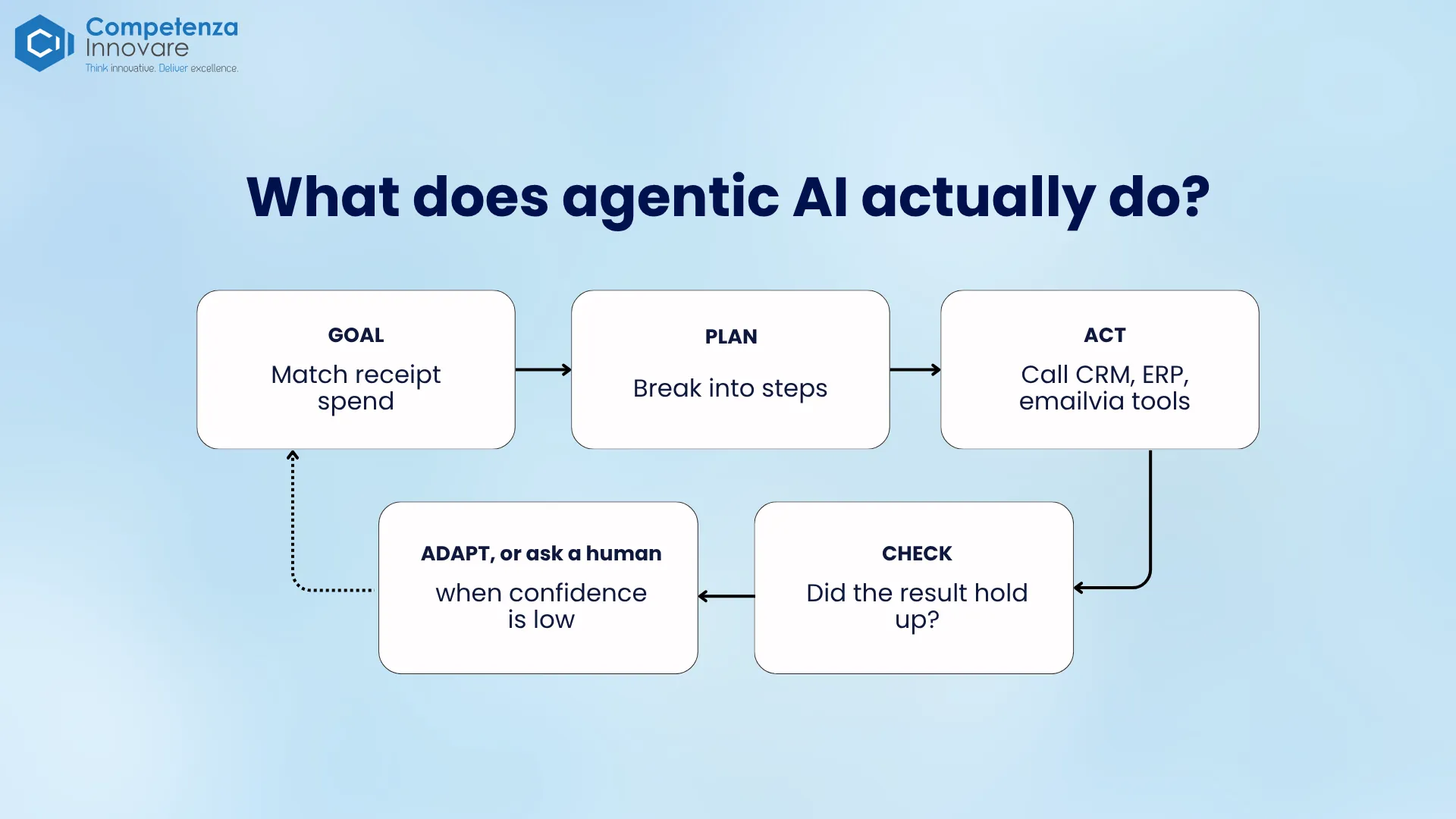
That last box matters most. A well-built agent knows when to stop and ask.
How is agentic AI different from chatbots, generative AI and AI agents?
The terms overlap, and most explainers blur them. Here is an easy way to segregate them: AI agents are task-focused components, while agentic AI is the wider capability of planning and coordinating them toward an outcome.

If you want the generative layer first, our generative AI consulting and development page covers where RAG and copilots fit before agents come in.
Why is the UAE government promoting agentic AI, and what does it mean for private businesses?
The UAE described its framework as a world first. Ministers and heads of government entities will be assessed on how quickly they adopt agentic AI during the two-year rollout. A follow-up Cabinet package added an 80,000-employee federal training programme.
For a private company, the effect is indirect and practical. Suppliers who work with government entities should expect faster, more automated approval cycles. Procurement questions will start to include how your own systems handle automation and data. And the talent market will shift as thousands of public employees learn to work alongside agents.
This is an inference, not a mandate. Nothing in the framework obliges private firms to adopt agentic AI. It does raise the baseline of what counts as normal.
Where does agentic AI work in UAE businesses today?
The strongest early use cases share three traits: high volume, clear rules, and mistakes you can reverse.
- Finance and reconciliation. Agents extract receipt data, match it to transactions, and flag unmatched items for review.
- Customer support. Agents resolve routine requests across chat, WhatsApp and email, then hand complex cases to a person with full context.
- Operations and approvals. Agents route onboarding steps, purchase approvals and exceptions with a traceable log.
Real estate and sales. Agents qualify inbound leads, update the CRM, and schedule viewings. - Logistics. Agents watch shipment exceptions and notify the right stakeholder.
Our AI agent development services page lists the agent types we build in each of these areas.
Who is agentic AI for, and who should wait?
It fits you if:
- You have a workflow that repeats hundreds of times a month and follows written rules.
- Your data sits in systems with APIs, such as an ERP, CRM or helpdesk.
- You can name an owner who will review exceptions weekly.
Wait if:
- Your process lives in people’s heads or WhatsApp threads with no written rules.
- The task is rare, high-stakes and irreversible, such as a one-off legal filing.
- You have no budget for monitoring after launch.
What can go wrong, and how do UAE and Saudi rules shape governance?
Most agent failures come from permissions and oversight. The model is rarely the culprit.
An agent with broad access can change a supplier’s bank details or send a message to the wrong customer. Three controls reduce that risk. Give each agent least-privilege access, so it sees only what its task needs. Log every tool call and action. Require human approval for high-impact steps such as payments.
In the UAE, the Personal Data Protection Law (PDPL) applies wherever an agent processes personal data, which includes employee records and customer messages. Decide where data is stored and who can query it before you connect anything. Larger firms building this across several systems can see how we approach it under enterprise AI development services.
Businesses operating across the border should watch Saudi Arabia. Its National Cybersecurity Authority opened draft AI Cybersecurity Guidelines for public consultation in July 2026. The scope explicitly covers generative and agentic AI, across governance, defense, resilience and third-party risk. The draft is not final as of this writing, so check the current status before relying on it.
How should a UAE business start with agentic AI?
- Pick one workflow. Choose a task with high volume, written rules and a clear owner. Receipt matching and ticket triage are common starting points.
- Map the current process. Record each step, each system touched, and each exception. This exposes the integrations you need.
- Set three KPIs. Cycle time, hours saved and error rate work for most pilots. Measure the baseline before the agent runs.
- Define permissions and approvals. List what the agent may read, write and trigger. Mark which actions need a human.
- Run a supervised pilot. Let the agent propose and a person approve for the first few weeks. Loosen approvals only as accuracy proves out.
- Review and expand. Compare results with the baseline, fix the exceptions, then pick the next workflow.
Teams that want help with step one can start from AI consulting and development, which covers use-case discovery and ROI scoring. For mostly rule-based workflows, AI automation services may be the lighter fit.
Share your candidate workflows with our team and leave with a ranked shortlist, and a rough effort estimate per workflow.
What have we seen building production AI for GCC teams?
At Competenza, we engineered the platform foundation for SiFi, a Riyadh-based spend platform, and contributed to its Musa’ed AI layer for receipt understanding and transaction matching. In the five-month first phase, SiFi grew from a few hundred users to 2,000+, and by the end of phase two it served 5,000+ business customers, per the client’s reported figures. The hard decision was what the agent does when it is unsure: it recommends a likely match at lower confidence and sends the rest to a person. Here is how that engagement worked.
Is agentic AI worth planning for now?
For most UAE businesses, yes, at pilot scale. The technology is mature enough to run bounded workflows, and the government’s timeline is moving the market faster than most procurement cycles.
Waiting for a perfect, fully autonomous system is the more common mistake. Agents earn trust the way new staff do, by starting with narrow tasks and reporting what they did. If the pilot works, it also becomes a first step in a wider digital transformation programme.
Start with one workflow and one owner. If you can describe it in a page, you can scope an agent for it.
Book a scoping call and leave with a shortlist of agent use cases, the permissions each would need, and the three KPIs to judge a pilot.
FAQs
What does agentic mean when it comes to AI?
It describes AI that acts with agency: it sets sub-goals, chooses actions and uses tools to reach an outcome instead of waiting for a prompt at each step. Think of it as the difference between an assistant that answers and one that completes the task.
What is the difference between agentic AI and AI agents?
An AI agent is a single component that performs a defined task. Agentic AI is the wider capability of planning and coordinating one or more agents toward an outcome.
Is ChatGPT or Claude agentic AI?
A plain chat conversation is not agentic, because you drive every step. A system built on the same kind of model becomes agentic when it is given tools, permissions and a goal to carry out across several steps.
What are the main risks of agentic AI?
The main risks are over-broad permissions, actions taken on wrong data, and no record of what the agent did. Least-privilege access, full action logs and human approval on high-impact steps address all three.
How much human oversight does an AI agent need?
Start with a person approving every action, then loosen approval only for low-impact, reversible steps once accuracy is proven. Payments, bank-detail changes and sensitive customer messages should keep a human approver.
What data should you never give an AI agent?
Give it only what its task needs. Keep credentials out of prompts, and avoid full ID documents, card numbers and health records unless the agent is purpose-built and approved to handle them. PDPL applies to personal data an agent processes, so minimise it by default.
How much does an agentic AI project cost in the UAE?
Scope drives price. As a planning range, AI-integrated products start from about AED 250,000, and single-module builds for SMEs run roughly AED 10,000 to AED 60,000. [VERIFY against Competenza’s current figures before publish.]
Is the UAE government actually using agentic AI?
The Cabinet approved a framework in April 2026 to move 50% of government sectors, services and operations to agentic AI within two years. A later approval added the first AI-enabled service bundles.