TL;DR
This guide compares the top application modernization companies in Dubai so you do not have to struggle to finalize between vendors that look similar on paper but differ significantly in architectural depth, compliance awareness, and execution focus.
We shortlisted them based on:
- Architectural approach
- Cloud and hybrid alignment
- Governance capability
- Scalability readiness
- Delivery ownership
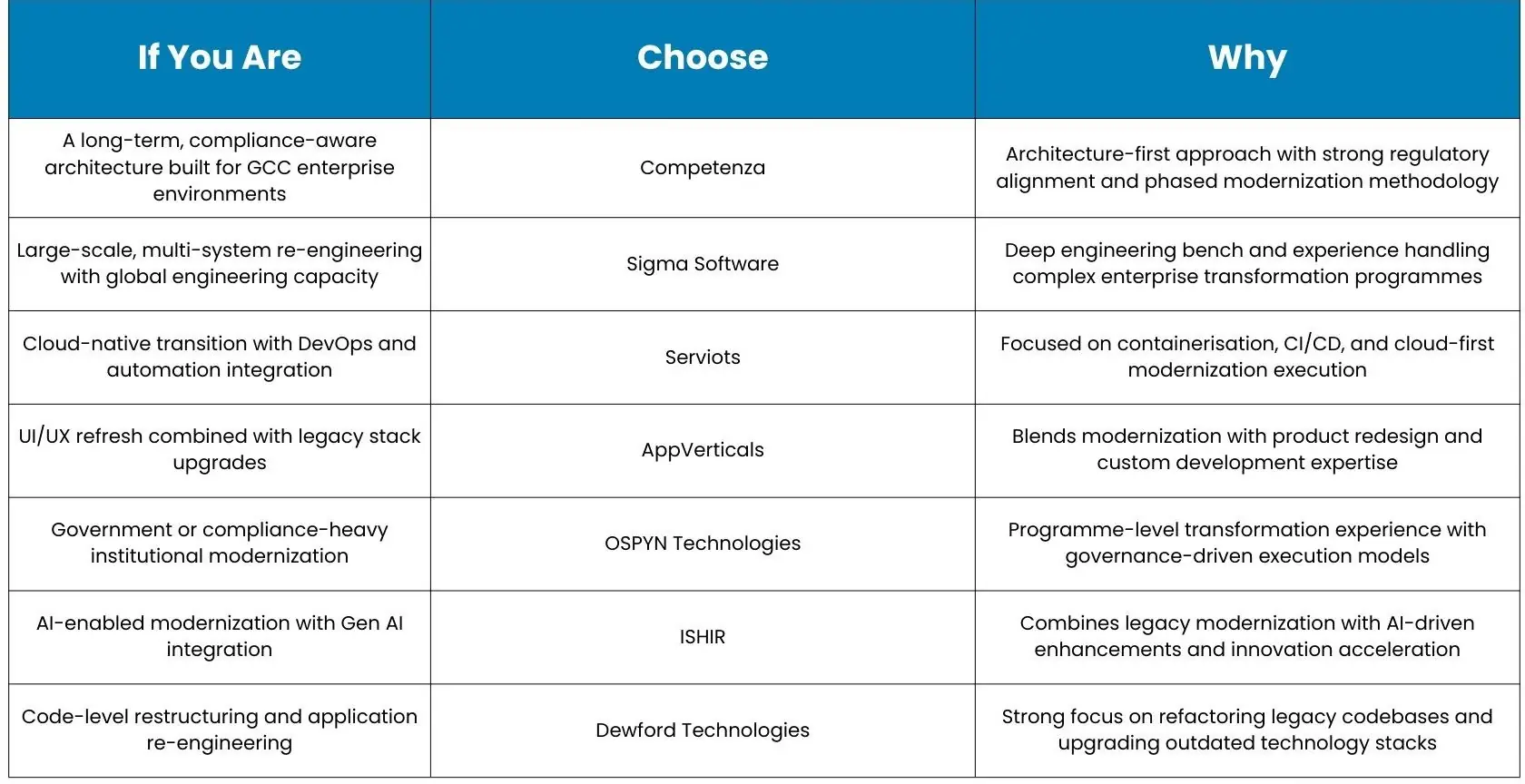
Here is a quick summary for your reference:
Introduction
Many organizations in Dubai are very aware that their legacy applications & systems are holding them back. Postponing Application Modernization often complicates integrations, forces manual scaling efforts, and exposes architectural weaknesses during security audits.
By 2026, most enterprises aren’t debating whether to modernize. They’re debating how to modernize without breaking what still works.
With the right application modernization company in Dubai, the organization can gain scalable architecture, structured governance, predictable cloud costs, and a faster deployment cycle.
But choosing the right modernization partner is tricky, as every vendor looks similar on paper. And ending up with the wrong modernization partner means not only delaying the project but also increasing operational risk, technical debt, and budget exposure.
This guide covers the top 7 application modernisation companies in Dubai and the evaluation criteria to keep in mind.
If your organisation is planning a legacy upgrade, this shortlist will help you move forward with confidence and clarity.
Here is a detailed guide to explain legacy system modernization.
What is Application Modernization?
Application modernisation is a structured transformation of legacy enterprise applications to cloud-aligned, secure, and integration-ready platforms that reduce operational risk and support long-term digital strategy.
It involves re-architecting large monolithic systems into modular or service-based structures, aligning infrastructure with a hybrid or multi-cloud strategy, reducing technical debt that limits agility, and embedding.
Here is why it is beneficial to modernize your legacy applications.
Top 7 data engineering companies in Dubai

1. Competenza

Competenza offers application modernization services to organisations that need to restructure legacy applications, migrate to hybrid or cloud environments, and reduce architectural risk without disrupting ongoing operations. Its approach centres on structural technology constraints rather than just delivering isolated upgrades.
They begin their engagement with a detailed assessment of existing systems, integration layers, infrastructure dependencies, and governance requirements.
What differentiates Competenza from others in the list is its architecture-first approach, compliance and residency awareness, and long-term engineering ownership.
Why we selected Competenza
We selected Competenza for its architectural depth, regulatory awareness, structured, phased modernization methodology, and enterprise delivery credibility.
Best for: Competenza is best for SMBs, mid to large organizations running complex legacy systems, organizations operating in regulatory sectors, and for CIOs seeking phased, low-disruption modernization projects.
Not ideal for: Competenza may be less suitable for businesses seeking only lift-and-shift migration, and for projects focused purely on UI redesign, without backend restructuring.
Here is how we modernized a legacy application for Abound Credit Union

2. SigmaSoftware

Sigma Software positions itself as a large-scale engineering partner capable of handling complex transformation programmes. They focus on helping organizations upgrade outdated systems, migrate workload to modern platforms, and improve performance through structured engineering.
Why we selected SigmaSoftware
We selected Sigma Software for its engineering bench and technical depth, and its ability to handle complex refactoring and platform migration.
Best for: Sigma Software is best for organizations requiring extensive development capacity, complex multi-system modernization programmes, and cross-border or multi-region transformation initiatives.
Not ideal for: Sigma Software is not ideal for organizations prioritizing UAE-specific regulatory alignment and businesses seeking a locally embedded GCC advisory partner.
3. Serviots

Serviots positions itself as a technology consulting and engineering company offering application modernization services centered on cloud adoption, DevOps integration, and performance optimization. Their approach is more agile and consultation-oriented.
Why we selected Serviots
We selected Serviots for their clear focus on cloud native transformation, strong DevOps and automation orientation, and structured modernization lifestyle support.
Best for: Serviots is best for organizations transitioning to cloud native environments, and companies looking to implement DevOps alongside modernization.
Not ideal for: Serviots may be less suitable for organizations requiring heavy regional compliance alignment, within UAE specific regulatory framework, and organizations seeking purely advisory architecture consulting without execution.
4. AppVerticals

AppVerticals help businesses refresh outdated applications to improve usability, scalability, and maintainability. Unlike other service agencies, they appear more product development-oriented, combining modernization with broader custom software and digital product services.
Why we selected AppVerticals
We selected AppVerticals for its code-level refactoring, reengineering, and its capability across web, mobile, and enterprise platforms.
Best for: AppVertical is best for businesses needing a legacy application refresh combined with UI/UX upgrades, organisations looking to modernise and redesign customer-facing platforms, and mid-sized enterprises seeking tech stack upgrades.
Not ideal for: AppVertical is not suitable for highly regulated GCC enterprises requiring deep regional compliance alignment and large-scale multi-system enterprise transformation programmes.
5. Ospyn

Ospyn positions itself as a programme evaluation transformation partner, particularly for structured, compliance-driven environments. Their orientation is optional, and implementation focused particularly in sectors where governance, documentation and rollout process are critical.
Why we selected Ospyn technology
We selected Ospyn technology for its strong experience in government and regulated environments, and for its capability to manage large-scale enterprise transformation programmes.
Best for: Ospyn technology is best for government and public-sector organizations, and for institutions prioritizing managed services alongside modernization.
Not ideal for: Ospyn technology may be less suitable for fast-moving enterprises seeking rapid architecture-led refactoring, and organizations prioritizing deep cloud -native architecture.
6. ISHIR

ISHIR positions itself as a digital innovation and engineering firm combining legacy application modernization with emerging technologies such as generative AI. They frame modernization as an opportunity to embed automation, intelligence, and AI-driven capabilities into enterprise applications.
Why we selected ISHIR
We selected ISHIR for its clear focus on combining modernization with Gen AI capabilities, strong digital product engineering background, and experience across cloud, AI, and enterprise integration.
Best for: ISHIR is best suited for organizations modernizing custom-facing or data-driven platforms, digital product-driven enterprises, and companies aiming to combine modernization with innovation acceleration.
Not ideal for: ISHIR may be less suitable for organizations focused purely on governance-heavy, compliance-driven restructuring and projects requiring a deeply localized advisory presence in Dubai.
7. DEWFORD technologies

Dewford Technologies offers application reengineering services with a strong focus on code-level restructuring and technology stack upgrades. Their approach is centred on analysing existing legacy codebases, refactoring, or rewriting outdated components, and migrating to modern frameworks or platforms.
Why we selected DEWFORD technologies
We selected Dewford Technologies for a clear focus on application reengineering, strong code refactoring, and restructuring capabilities, and custom development capability alongside modernization.
Best for: Dewford Technology is best for organizations with legacy applications requiring code refactoring, business upgrading outdated tech stack, and companies seeking technical stabilization before scaling.
Not ideal for: Dewford Technology is not ideal for highly regulated GCC enterprises requiring deep regional compliance alignment, organizations seeking architecture-led hybrid cloud advisory.
How to choose the right application modernization company

Selecting the secure and compliant application modernization partners is crucial because the wrong one doesn’t just delay a migration, but also reshapes your cost structure, compliance posture, and operational risk for years.
These are some factors that you should consider before selecting an application modernisation company.
1. Architecture Approach
The application modernisation service provider should take an interest in understanding system dependencies, integration layers, data flow, and data structure constraints before recommending a cloud platform or framework.
This consideration is important because modernization without structural analysis often results in technical debt being relocated rather than removed.
2. Compliance Alignment
When it comes to Dubai, application modernization is rarely a purely technical exercise. Therefore, choose a partner that considers data residency expectations, audit requirements, sector regulations, and hybrid infrastructure decisions from day one. This is important because retrofitting governance control once designing is done is more disruptive.
3. Modernisation Capability
It is also important to distinguish between cloud migration and genuine modernization. Some providers focus only on infrastructure relocation, while only a few invest in refactoring monolithic systems, enabling APIs, improving cost observability, and designing for scalability. This difference is important because it determines whether an organization gains flexibility or simply shifts operating expenses to a new environment.
4. Strategic Fit
And lastly, consider the firm’s orientation. Some companies specialize in architecture-led, governance-heavy transformation. Others bring large engineering capacity for complex rebuilds. A third group emphasizes innovation, automation, or AI integration. The right choice depends on your strategic objective. If the priority is regulatory alignment or structural stability, an architecture-first consultancy may be more appropriate. If the goal is global scale reengineering, engineering depth becomes critical.
The right partner is the one that will treat your application modernization project as a strategic transformation and not just a migration project.
How Competenza Stands out
Competenza stands out for its architectural depth and regional alignment.
Competenza begins every engagement with a structured assessment of legacy dependencies, integration layers, data governance exposure, and infrastructure constraints. This approach helps their customers eliminate technical debt.
Businesses within Dubai and wider GCC operate within evolving compliance environments, sector-specific governance standards, and hybrid infrastructure relationships. Competenza integrates these constraints into the design phase rather than testing them as post-migration adjustments. This reduces audit risk and prevents disruptive redesign cycles.
Another factor, which Competenza takes care of, is controlled execution. Instead of lift and shift promises, they support phased transformation aligned with business continuity. This approach helps their customers in protecting uptime and operational stability during the transition.
And finally, Competenza’s engagement model reflects partnership rather than augmentation. Competenza positions itself as accountable for architectural outcomes and not just delivery.
Conclusion
Here is what our team says about Application Modernization projects in 2026:
Application modernization should not begin with vendor shortlisting. It should begin with internal clarity.
Review your current architecture. Identify where legacy systems are increasing cost, slowing releases, or creating compliance exposure. Define your primary objective, whether that is scalability, governance alignment, or cost control.
Then evaluate partners based on architectural depth and execution discipline, not just cloud credentials.
Competenza stands as a multi-application modernization service provider with its architecture-first, GCC-aware modernization approach, focused on reducing technical debt and protecting business continuity.
If modernization is on your roadmap, the next step is simple: Initiate a structured architecture assessment before committing to migration.
FAQs
How long does an application modernization project usually take?
It depends on system complexity, integration depth, and the chosen approach.
A simple lift-and-shift migration may take 2 to 4 months. Partial refactoring or replatforming projects often run between 4 to 8 months. Full-scale re-architecture of mission-critical enterprise systems can extend to 9 to 18 months, especially in regulated environments.
The timeline is driven less by code volume and more by dependency mapping, data migration complexity, compliance controls, and phased rollout planning.
What are the main benefits of modernizing legacy applications?
Modernisation reduces structural risk and unlocks scalability.
Key benefits typically include:
- Lower infrastructure and maintenance costs
- Improved performance and scalability
- Faster release cycles
- Stronger security controls
- Better integration through APIs
- Improved cost visibility in cloud environments
For enterprise leaders, the real advantage is shifting IT from maintenance-heavy operations to a scalable, innovation-ready architecture.
Do these companies specialize in specific industries or technologies?
Yes, and this varies significantly.
Some firms focus on regulated sectors such as finance, government, or healthcare, where governance and compliance alignment are critical. Others specialise in cloud-native transformation, DevOps enablement, AI integration, or large-scale engineering execution.
It is important to align the vendor’s sector exposure and technical strengths with your business environment and architectural objectives.
What are the risks involved in application modernization?
Application modernisation carries operational and financial risk if not managed carefully.
Common risks include:
- Underestimating
- legacy complexity
- Data migration failures
- Budget overruns
- Business disruption during cutover
- Compliance gaps during transition
- Moving technical debt to the cloud without restructuring
These risks can be mitigated through phased execution, detailed architectural assessment, governance planning, and structured rollback strategies.
Modernisation has a high impact. It should be approached as a controlled transformation, not a rushed migration.