TL;DR
Custom E-commerce in GCC is more of an infrastructure decision than just a storefront one.
To build it correctly:
Define VAT and revenue logic early; audit integrations before development; align hosting with respective GCC data residency rules; embed PDPL compliance into the architecture; stress-test for peak traffic; and design for scale across geographies. Done right, custom ecommerce protects revenue, reduces risk, and supports long-term regional growth.
Introduction
Have you ever found yourself saying, “This e-commerce platform can’t handle that.” When it comes to pricing discussions, or when someone suggests launching a B2B portal, or when finance asks for clearer reporting, you doubt the capability of your platform.
And this doubt is not unfounded, because you may have experienced complex checkout logic that broke under customizations or unpredictable integration behaviour, and performance drops during high campaign spikes like Ramadan or White Friday. And this makes you question your ecommerce platform’s capabilities.
This is when the discussion shifts from “how should we customize this” to “should we build something that actually fits us?”
Custom e-commerce is rarely a vanity decision. It is often triggered by operational friction. But moving to custom software is not simple either; it affects budget, architecture, integration, timelines, and internal accountability.
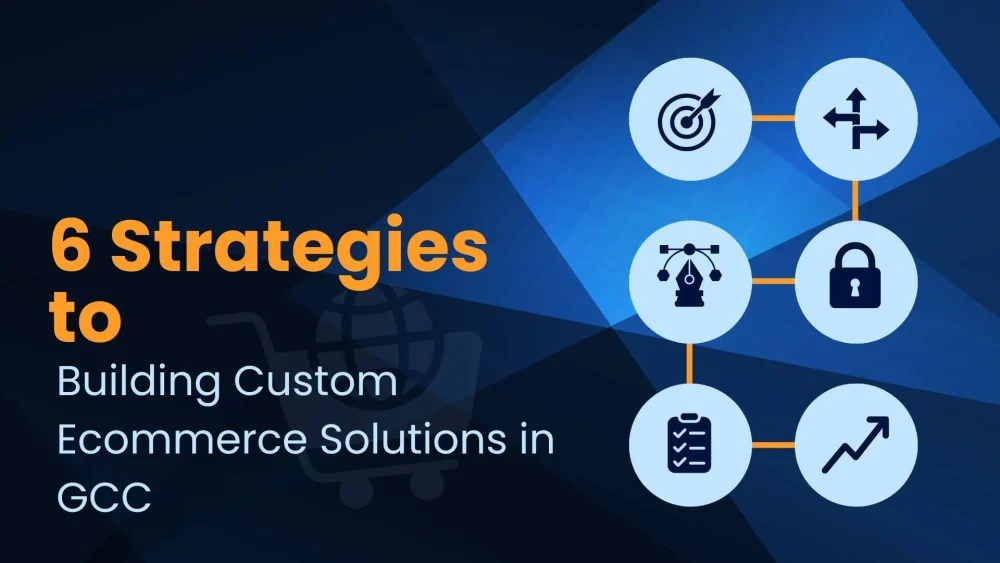
This guide walks you through thesix essential steps to build custom e-commerce solutions in the GCC. It also discusses what to keep in mind before development starts and where teams often underestimate complexity.
What is custom e-commerce development
Custom e-commerce development means building your online commerce platform around your specific business needs, with your revenue logic, integrations, checkout flow, data structure, and scalability defined first, rather than forcing your business to fit within platform limitations.
In early-stage businesses, basic SaaS platforms may work. But as organisations expand across diverse GCC markets, add B2B channels, or face compliance pressure, platform ceilings become visible.
Custom e-commerce becomes necessary when:
- Integration complexity grows
- Data residency becomes non-negotiable
- Seasonal traffic concentration increases risk
- Multi-entity operations require governance
As GCC ecommerce matures, businesses are also exploring AI-driven automation and autonomous decision systems. If you’re evaluating how this fits into your roadmap, explore how agentic AI is reshaping ecommerce across the GCC.
Essential Features for Custom E-commerce Solutions
In GCC, customized ecommerce solution platforms operate in a complex environment of seasonal traffic spikes, stringent regulatory oversight, COD-heavy payment behaviour, cross-border expansion, and high customer expectations. You should build your custom ecommerce solution with these realities in mind.
Hence, in GCC, a custom e-commerce solution must
- Sustain heavy seasonal traffic without revenue disruption
- Comply with VAT and PDPL regulations across multiple jurisdictions
- Maintain data residency and hosting control where required
- Integrate cleanly with ERP, warehouse, and finance systems
- Support diverse payment behaviours, including COD and BNPL
- Protect against fraud and security threats during peak campaigns
- Scale without forcing a rebuild within a few years
Build these architectural foundations from day one to avoid revenue loss, compliance exposure, and costly rework.
The table below outlines the essential feature areas and their business impact.

Key Steps to Creating a Custom e-commerce Solution
In the GCC region, to make a custom e-commerce project a big success, you have to approach it as an architecture decision, not a storefront redesign. You must plan deliberately for VAT complexity, PDPL regulations, COD-heavy behaviour, and seasonal traffic spikes.
Here are the six essential steps.
1. Define multi-country revenue and tax logic.
Before you discuss the technology, define how your business operates across the UAE, Saudi Arabia, and other GCC markets.
This includes defining:
- VAT differences
- Multi-currency pricing
- Cash on delivery support
- B2B approval workflows
- Distributor and marketplace commission logic
Doing this step right helps you align architecture naturally with business operations. It makes financial reporting accurate and predictable. This also makes the small border expansion smoother.
If ignored
Ignoring this may result in Tax inconsistencies, reporting inconsistencies, and checkout friction emerging post-launch
2. Audit ERP, warehouse, and finance integration
Before you begin development, run a mappingof every system your ecommerce platform will depend on. In most GCC mid-to-large organizations, ecommerce connects to most of these:
- ERP systems manage finance and procurement
- Warehouse management system handling inventory
- Logistics platform coordinating delivery
- Accounting systems calculating VAT
- Payment gateways reconciling transactions
At a minimum, you should map to these:
- Real-time inventory sync across the warehouse and store
- Order to cash workflows, from checkout to settlement
- VAT calculation reporting alignment with ERP
- Return and refund processes, including finance adjustments
This helps run operations with predictability rather than friction. It also improves execution speed and preserves profit margins.
If ignored
Missing integration mappings may lead to increased stock mismatches and delayed order fulfilment due to sync failures between systems.
3. Select the appropriate GCC hosting and infrastructure
In the GCC, hosting is not a technical choice; it is a regulatory, contractual, and enterprise governance decision. That’s why you should consider infrastructure decisions even before you start development.
Early in the project, you must clearly define
- Where will customer data reside
- Whether UAE-based or Saudi-based regions are required for hosting
- Whether hybrid hosting is necessary
- Disaster recovery location and failover timeline
- Backup policies
For many organizations, especially in government-linked healthcare, finance, and large retail groups, data residency expectations are non-negotiable.
This helps to accelerate stakeholder approval and reduce compliance friction. It also creates a stable, scalable foundation without disrupting rework later.
If ignored
Ignoring this may lead to conflict with regulatory or contractual requirements later in the project. This can result in delayed approvals, forced migration, or costly redesign mid-development.
4. Embed PDPL and Data governance from day one
Plan early about how customer consent will be captured, how data requests will be handled, who can access what information, and how activity will be logged.
Building governance during the handling stage helps you reduce regulatory risk, build customer trust, and position the business confidently with government-linked partners.
If ignored
If data governance is not structured from the start, teams struggle when customers request access or deletion of their data. Compliance becomes reactive and stressful.
5. Stress test for seasonal traffic spike
You will be launch-ready once you have completed all the steps above. But before you launch, make sure you know how the system behaves when things get busy. Stimulate Ramadan-level traffic, test how checkout performs when thousands of users hit at once, check whether payment gateways respond under pressure, and confirm that ERP sync holds steady when volume surges.
If the stress test is done properly, campaign days feel controlled instead of chaotic.
If ignored
Ignoring this step may lead to more abandoned carts, a spike in support tickets, an inability to convert traffic, and the wasting of marketing budgets.
6. Design for scalability and multi-entity government
From the beginning, build a system that can handle growth. That means setting up clear role-based access control, supporting multiple brands or subsidiaries within one structure, and keeping the architecture modular enough to expand into the new GCC market without rebuilding everything.
If you plan scale and governance properly, you can confidently launch into new markets, structure admin access, and accelerate innovation. The system you set up for scale and governance supports expansion without hindering it, protecting both operational stability and agility.
If ignored
If you do not design the platform for that structure, growth starts creating friction instead of opportunity.
Challenges of Custom E-commerce Development
Though a custom B2B ecommerce solution offers control and scalability, it comes with a lot of “Ifs”, and “BUTs”, especially in the GCC region. In the GCC region, where VAT complexity, PDPL requirements, seasonal revenue spikes, and multi-entity operations are common, the stakes are higher.
Understanding these challenges helps you approach customized ecommerce solution development with structure rather than uncertainty.
Here are key challenges and how to manage them effectively.
1. Higher upfront investment
Custom e-commerce development includes architectural planning, integration, compliance, and performance testing. This involves a lot of financial commitment.
To overcome this challenge, instead of focusing on development cost, evaluate the total cost of ownership over three to five years.SaaS transaction fees, customization layers, and integration patchwork can exceed the custom investment long term. This will help you set a strategic budget and gain clarity on long-term value.
2. Longer development timelines
In GCC, the deployment timeline is stretched by enterprise approvals, ERP alignment, and infrastructure reviews. You can’t expect to deploy a custom ecommerce solution in just weeks.
For a realistic, controlled timeline, clearly define the launch scope and separate core requirements from future enhancements. You can also set milestones tied to integrations, compliance validations, and performance testing.
This improves stakeholder confidence and reduces the risk of mid-project expansion.
3. Integration complexity with ERP and warehouse system
GCC organizations often rely on established ERP systems and structured warehouse operation softwares. Custom ecommerce solutions must align precisely with finance, VAT reporting, and logistics workflow.
For this obstacle, you can conduct a structured integration audit before development begins. Map dataflows, ownership, and exception scenarios. This leads to improved operational stability, faster fulfilment, and fewer manual reconciliations during high-volume sales periods.
4. Compliance and data residency pressure
PDPL requirements in the UAE and Saudi Arabia affect how customer data is handled. In GCC hosting decisions, consent workflows, and audit logging must align with legal standards.
If governance is not structured early, teams may face regulatory questions during expansion or audits.
That’s why you should consider making data governance and hosting decisions during the architecture phase. This helps regulatory approvals move faster, improves audit readiness, and avoids costly rework later.
5. Seasonal traffic risk
Ramadan, White Friday, and National Day campaigns can generate sudden surges in traffic. Revenue concentration during these periods increases pressure on performance.
To sustain these traffic surges, conduct load testing and stress stimulation before peak seasons. Implement monitoring tools and define failover procedures so teams are not reacting during live campaigns.
This helps protect campaign revenue and convert marketing investments into actual sales rather than lost opportunities.
Development of a scalable and stable e-commerce platform boils down to choosing the right tools, team, and platform. This guide can help you choose the right options.
How Competenza supports your custom ecommerce journey
Moving to custom ecommerce solutions requires complete architectural clarity, integration disciplines, compliance awareness, and regional understanding.
Competenza approaches customized ecommerce solutions as structured programs, not as design projects. That means they
- Define revenue logic before writing code
- Map ERP and warehouse integrations early
- Align the hosting strategy with GCC data expectations
- Embed PDPL and governance into architecture
- Stress testing before peak campaign season
Their goal is simple: reduce uncertainty before it becomes costly.
For example, Competenza rebuilt an e-commerce website for its client, Bonobo Planet. They were facing a slowdown of key pages during peak campaigns. Competenza rebuilt Bonobo Planet’s ecommerce website for speed, consistent discovery, and safe weekly releases.
This way, they helped them achieve a 12% higher add-to-cart rate, 0% release failures, and a 30% higher engagement rate.
Whether you are evaluating the shift from SaaS or preparing a multi-market rollout across the GCC, the right sequence makes the difference between controlled growth and reactive rebuilding.
If you are planning a custom ecommerce initiative, start with an architecture review before committing to development. The clarity gained upfront often prevents months of correction later.
If you are looking for an e-commerce development partner in Dubai, read this guide. It will help decide the right e-commerce development partner.
Conclusion
A custom ecommerce solution in the GCC is more of an infrastructure decision than a cosmetic one that affects revenue stability, regulatory exposure, operational speed, and long-term scalability.
If you are considering a shift from off-the-shelf platforms, begin with clarity. Review your revenue logic, integration dependencies, hosting strategy, and compliance posture. Map what exists today and identify where constraints are slowing execution. The gaps usually reveal themselves faster than expected.
Avoid rushing into development. Structure the decision, validate architecture, and stress-test assumptions before committing a budget. When approached methodically, a custom B2B ecommerce solution becomes a controlled investment rather than a reactive rebuild.
At Competenza, this is how we approach custom ecommerce initiatives in the GCC: we start with architecture and readiness before writing code.
The next step is simple: assess your readiness before you build.
When approached methodically, customized e-commerce solutions become a controlled investment — not a reactive rebuild.
FAQs
How much does it cost to build a custom e-commerce solution?
The cost varies significantly depending on scope, integrations, compliance requirements, and performance expectations. A simple custom storefront with limited integrations may require a moderate investment. In contrast, a multi-country GCC deployment with ERP integration, VAT logic, PDPL compliance, and peak-load optimisation will be more expensive.
Instead of asking only about build cost, it helps to evaluate total cost over three to five years, including hosting, maintenance, integrations, and scalability. In many cases, custom solutions are more cost-efficient in the long term than growing SaaS subscription and transaction fees.
How long does it take to develop a custom e-commerce platform?
Timelines depend on complexity. A focused build with a defined scope can take a few months, while enterprise-grade platforms with ERP alignment, data residency planning, and multi-market rollout may take longer.
In the GCC context, approvals, compliance validation, and infrastructure decisions can extend timelines. Clear scoping and structured milestones significantly reduce delays and prevent mid-project redesign.
What are the key features every custom e-commerce solution should have?
At a minimum, a GCC-ready custom platform should include:
- Scalable performance architecture for seasonal traffic spikes
- Flexible VAT and multi-country pricing logic
- Strong ERP and warehouse integrations
- PDPL-compliant data governance
- Secure payment and fraud protection
- Role-based access control for multi-entity operations
These are not enhancements; they form the operational backbone of a sustainable ecommerce system in the region.
Do I need technical expertise to manage a custom e-commerce solution?
You do not need to write code internally, but you do need structured ownership. Custom ecommerce requires oversight of architecture, integrations, compliance, and roadmap planning.
Many organisations appoint a digital lead or product owner to coordinate between business and technical teams. With proper governance and the right delivery partner, operational management becomes structured rather than technical.
How do I choose the right technology stack for my custom e-commerce platform?
The right stack depends on your business model, integration environment, performance expectations, and compliance requirements. There is no universal answer.
Start by defining revenue logic, integration dependencies, hosting constraints, and long-term expansion plans. The technology stack should support those decisions, not dictate them. Architecture-first thinking reduces the risk of selecting tools that limit growth later.