Saudi Arabia Digital Transformation: What Vision 2030 Requires of Tech Companies
Vision 2030 has been a game-changer for Saudi Arabia’s technology landscape, creating unprecedented opportunities for tech enterprises and startups. In 2026, Saudi Arabia’s digital transformation isn’t just policy—it’s the operational reality that determines market access, regulatory compliance, and competitive advantage.
For tech companies based out of or targeting Saudi Arabia, this means every product decision, architecture choice, and partnership must align with their digital infrastructure requirements. NEOM’s technology infrastructure projects are creating new integration requirements, government digitization initiatives are establishing API standards, and regulatory frameworks are becoming more sophisticated.
Aligning with the Saudi Arabia Digital Transformation Strategy 2026 is essential for market success in the Kingdom. Whether you’re a startup building your first MVP or an enterprise scaling existing solutions, your strategy must map to Vision 2030 pillars, particularly the “Digital-by-Design” mandate.
In this article, we’ll break down a digital transformation blueprint for every tech company targeting Saudi Arabia in 2026: Compliance requirements that impact your tech stack, step-by-step integration strategies, and proven frameworks for building compliant, scalable solutions in Saudi Arabia.
Saudi Arabia Digital Transformation Initiatives in 2026
Saudi Arabia’s tech ecosystem has evolved rapidly, creating a sophisticated digital infrastructure foundation that tech companies must understand and leverage.
The regulatory environment has matured significantly. The Communications and Information Technology Commission (CITC) has established clear cloud computing frameworks, the National Cybersecurity Authority (NCA) has implemented comprehensive security standards, and the Data and Artificial Intelligence Authority (DAIA) provides governance guidelines for AI implementation.
Government digitization has accelerated, with most ministry services now offering API access for integration. This creates opportunities for tech companies to build solutions that connect with government systems, but also requires understanding specific integration protocols and compliance requirements.
Private sector adoption of cloud services, AI tools, and digital platforms has increased, driven by both regulatory requirements and competitive pressure. Smart city initiatives in major urban centers are creating demand for IoT integration, data analytics platforms, and citizen service applications.
Here is the status quo Tech Infrastructure Reality:
- Government APIs are available for most core services
- CITC cloud certification programs are operational
NCA cybersecurity frameworks are enforced across sectors - NEOM tech infrastructure projects are accepting vendor applications
- Local data center capacity is expanding to meet sovereignty requirements
Digital Transformation Challenges in Saudi Arabia for Tech Companies
Saudi Compliance Requirements: PDPL, NCA ECC and Cloud Rules
Investing in Saudi digital infrastructure requires translating complex regulatory frameworks into concrete technical architecture. Success in the Kingdom’s 2026 digital landscape depends on implementing specific mandates from day one, particularly the SDAIA Personal Data Protection Law (PDPL) and NCA Essential Cybersecurity Controls (ECC).
CITC Cloud Requirements for Tech Companies:
- Data classification and storage location compliance
- Encryption standards implementation (AES-256 minimum)
- Audit logging with immutable storage requirements
- Incident response procedures with government notification protocols
Practical Implementation Steps:
- Download CITC’s Technical Standards Document and create a compliance checklist for your specific tech stack
- Implement data classification tagging in your database and file storage systems
- Set up automated compliance monitoring that alerts when data handling violates location or encryption requirements
- Create incident response playbooks that include required government notifications and documentation
Code-Level Consideration: Ensure your application logs include all required audit trails from the initial development phase, rather than retrofitting compliance features later.
Integration with Legacy Government Systems
Common Integration Challenges:
- Government systems using outdated authentication protocols
- Lack of standardized API documentation across ministries
- Data format inconsistencies between old and new systems
- Performance limitations when connecting high-speed applications to legacy databases
Technical Solutions:
- Build API Gateway Layers: Create middleware that translates between your modern API and legacy system protocols
- Implement Asynchronous Processing: Use message queues to handle slow legacy system responses without blocking your application
- Design Data Transformation Pipelines: Build automated tools that convert between legacy data formats and your application’s requirements
- Create Fallback Mechanisms: Ensure your application can operate with limited legacy system connectivity
A comprehensive guide to digital transformation in Saudi Arabia reveals a unique “Startup Advantage.” Unlike large enterprises burdened by legacy systems, startups can design integration flexibility into their architecture from the outset. This agility makes them attractive partners for government giga-projects—like NEOM or the Red Sea Global—which require rapid deployment and seamless connection to national platforms.
Technical Talent and Team Building
Building tech teams in Saudi Arabia requires balancing technical expertise with local market knowledge and cultural understanding. Startups face unique challenges in attracting senior technical talent while meeting Saudization requirements.
Talent Strategy for Tech Companies:
- Remote-First Development Teams: Build core technical capabilities that can work across time zones with local Saudi business development and compliance teams
- Partnership with Local Universities: Create internship and graduate hiring programs with King Fahd University, King Saud University, and other technical institutions
- Skills-Based Hiring: Focus on problem-solving ability and learning capacity rather than specific technology experience, then provide intensive technical training
- Cultural Integration Training: Ensure international team members understand Saudi business practices and communication styles
Practical Team Structure:
- Local business development and government relations roles
- Technical architects who understand both global best practices and Saudi compliance requirements
- DevOps engineers familiar with local cloud
- infrastructure and security requirements
- Arabic-speaking UX designers for consumer-facing applications
Vendor Selection and Partnership Strategy
Tech companies must choose technology partners, cloud providers, and service vendors that understand Saudi Arabia’s unique requirements while providing global-scale capabilities.
Partnership Evaluation Framework for Tech Companies: Decision Framework:
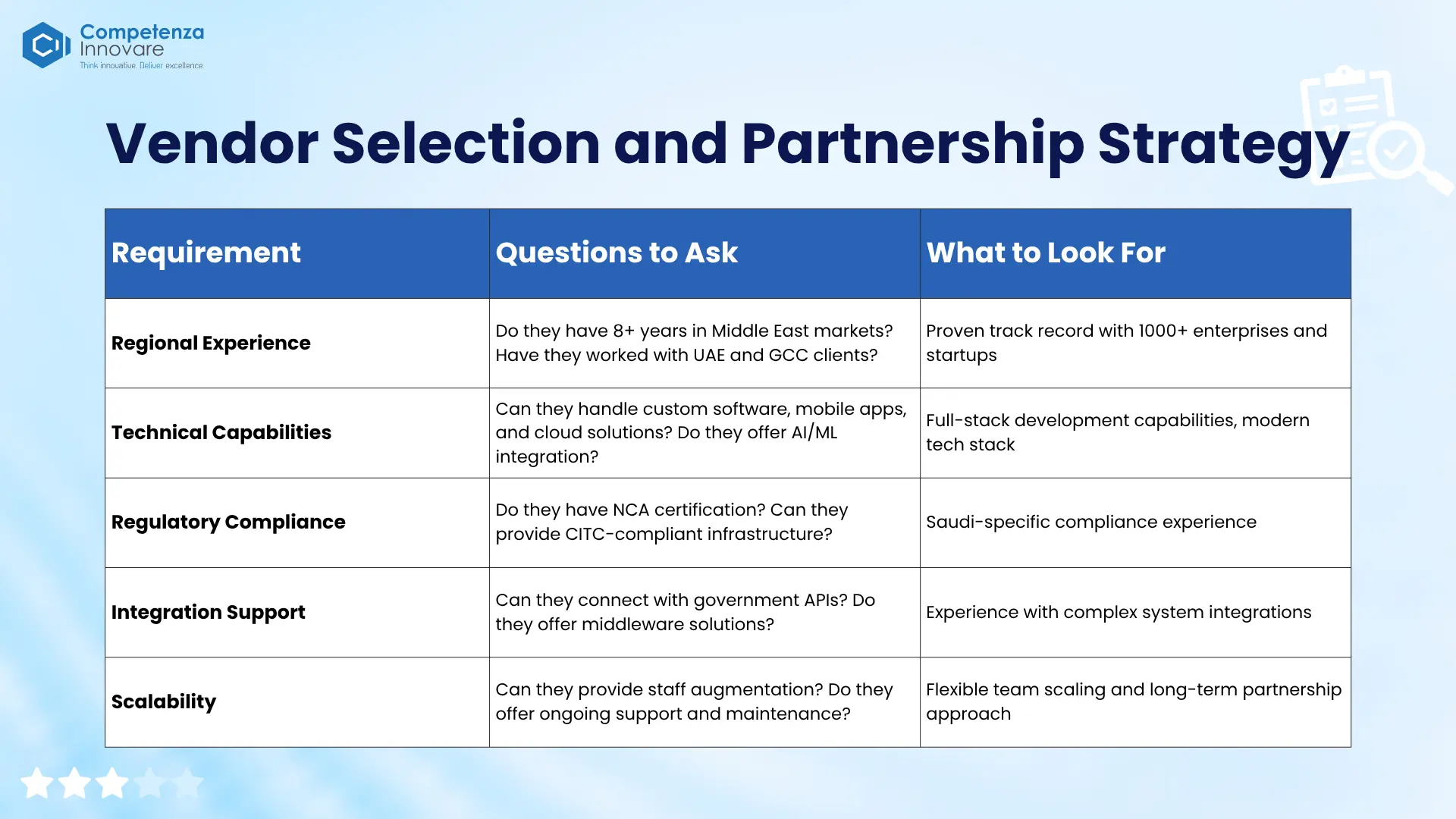
- Start with compliance-first vendors for core infrastructure
- Choose local partners for government relations and business development
- Select global vendors for specialized technical capabilities that aren’t available locally via staff augmentation
- Build redundancy across multiple vendors to avoid single points of failure
Emerging Opportunities for Tech Companies
Government Digital Services Market
Saudi Arabia’s government digitization creates direct opportunities for tech companies to build citizen-facing applications, internal government tools, and integration platforms that connect different ministry systems.
Specific Opportunities:
- Digital Identity Integration: Build applications that integrate with Absher and other national identity systems
- Government Service APIs: Create tools that help businesses integrate with ministry APIs for licensing, permits, and compliance reporting
- Arabic Language Processing: Develop NLP and AI tools specifically designed for Arabic government documents and communication
- Citizen Mobile Applications: Build apps that provide unified access to multiple government services
Smart City Technology Integration
NEOM, Riyadh, and Jeddah smart city initiatives create opportunities for tech companies specializing in IoT, data analytics, and urban technology solutions.
Technical Requirements for Smart City Projects:
- Real-time data processing capabilities
- Integration with multiple sensor types and data sources
- Arabic language interfaces for citizen-facing applications
- Compliance with local data sovereignty requirements
AI and Machine Learning Applications
Saudi Arabia’s national AI strategy creates opportunities for tech companies building AI tools, but requires understanding specific regulatory and cultural considerations.
Sector-Specific Opportunities:
- Healthcare AI: Diagnostic tools that work with Arabic medical terminology and local health data formats
- Financial AI: Fraud detection and risk assessment tools that understand Islamic banking principles
- Educational AI: Learning platforms designed for Arabic language instruction and cultural content
Fintech and Digital Payments
Saudi Arabia’s financial sector digitization creates opportunities for fintech startups and payment technology companies.
Key Technical Requirements:
- SAMA Regulatory Compliance: Understand Saudi Arabian Monetary Authority requirements for financial technology
- Islamic Banking Integration: Build systems that support Islamic financial principles and products
- Multi-Currency Support: Handle both local and international currency transactions
- Mobile-First Design: Optimize for smartphone usage patterns in Saudi Arabia
Saudi Digital Transformation Roadmap: Four Steps for Tech Companies
Assess Your Saudi Market Readiness
Before entering the Saudi market, tech companies should evaluate their readiness across technical, regulatory, and business dimensions.
Technical Readiness Assessment:
- Can your application handle Arabic text input and display correctly?
- Does your infrastructure support data residency requirements?
- Are your APIs compatible with government integration standards?
- Can your system scale to handle enterprise and government user volumes?
Regulatory Readiness Checklist:
- CITC cloud compliance capability
- NCA cybersecurity framework implementation
- Data protection and privacy compliance procedures
- Incident response and government notification protocols
- Arabic language user interface options
Business Readiness Evaluation:
- Do you have local business development capabilities?
- Can you provide Arabic language customer support?
- Do you understand Saudi procurement and contracting processes?
- Have you identified potential local partners and system integrators?
Build Compliance-First Architecture
Design your technical architecture to meet Saudi regulatory requirements from the beginning, rather than retrofitting compliance features later.
Architecture Principles:
- Data Sovereignty by Design: Ensure all Saudi customer data can be stored and processed within the Kingdom
- Audit Logging from Day One: Build comprehensive activity logging that meets government audit requirements
- Multi-Language Support: Design database schemas and user interfaces to handle both Arabic and English content
- API-First Integration: Create APIs that can connect with both modern cloud services and legacy government systems
Implementation Framework:
- Start with data classification: Tag all data types according to Saudi regulatory requirements
- Implement encryption standards: Use CITC-approved encryption methods for data at rest and in transit
- Build monitoring dashboards: Create real-time compliance monitoring that alerts on potential violations
- Design for audit readiness: Ensure all system activities can be easily audited and reported to authorities
Select Strategic Technology Partners
Choose technology partners who understand both global best practices and Saudi-specific requirements.
Partner Categories to Consider:
- Cloud Infrastructure: Providers with Saudi data centers and CITC certification
- System Integration: Local firms with government relationships and Arabic language capabilities
- Cybersecurity: NCA-certified security providers who understand local threat landscapes
- Business Development: Local partners who can navigate government procurement and enterprise sales
Partnership Evaluation Process:
- Request compliance certifications and verify their validity with Saudi authorities
- Ask for Saudi customer references and speak directly with existing clients
- Test Arabic language support and cultural understanding in preliminary discussions
- Evaluate long-term scalability and ability to grow with your business
Plan for Rapid Scaling
Design your business and technical infrastructure to handle rapid growth in the Saudi market
Growth Preparation Checklist:
- Auto-scaling cloud infrastructure configuration
- Documented hiring and onboarding processes for Saudi team members
- Arabic language customer support procedures and training materials
- Automated compliance monitoring and reporting systems
- Partnership agreements with local & global service providers for rapid expansion support
What to Do in the Next 90 Days
In 2026, healthcare digital transformation in KSA is centered on shifting from a fragmented system to a unified, value-based national ecosystem. This evolution is driven by the Health Sector Transformation Program, which integrates private providers into the National Platform for Health and Information Exchange (NPHIES).
Despite these advancements, the challenges of digital transformation in Saudi Arabia remain significant for tech-heavy sectors. Organizations must navigate strict SDAIA Personal Data Protection Law (PDPL) mandates that require absolute in-country data residency and 72-hour breach reporting.
Tech companies that invest in understanding Saudi Arabia’s digital transformation requirements will find a rapidly growing market with government support, enterprise demand, and opportunities for long-term partnerships.
Ready to evaluate your Saudi market opportunity? Partner with Team Competenza, who combine 8+ years of Middle East market expertise with comprehensive technical capabilities. From custom software development to AI/ML solutions, the right strategic partner can help you navigate Saudi Arabia’s regulatory landscape while delivering results 76% faster than traditional approaches.
FAQs
What specific technical standards must my application meet for CITC compliance?
Applications must implement AES-256 encryption, maintain audit logs with immutable storage, support data classification tagging, and provide incident response capabilities with government notification features.
How do I integrate my application with Saudi government APIs?
Start by registering with the relevant ministry’s developer portal, obtain API credentials through the official application process, implement OAuth 2.0 authentication where required, and build error handling for legacy system limitations.
What cloud infrastructure options are available for data sovereignty compliance?
Saudi-based data centers from STC, Alibaba Cloud Saudi, and other CITC-certified providers offer compliant infrastructure options. Ensure your chosen provider has current CITC certification and can support your specific technical requirements.
How can I ensure my application works properly with Arabic text?
Implement UTF-8 encoding throughout your system, test with Arabic text input and display, ensure proper right-to-left text rendering, and validate that search and sorting functions work correctly with Arabic content.
What cybersecurity requirements must my application meet?
Implement NCA-approved security frameworks, maintain comprehensive audit logging, provide incident response procedures, ensure encryption for data at rest and in transit, and prepare for security assessments and penetration testing.
How do I handle legacy system integration challenges?
Build API gateway layers for protocol translation, implement asynchronous processing for slow legacy responses, create data transformation pipelines for format conversion, and design fallback mechanisms for limited connectivity scenarios.