TL;DR
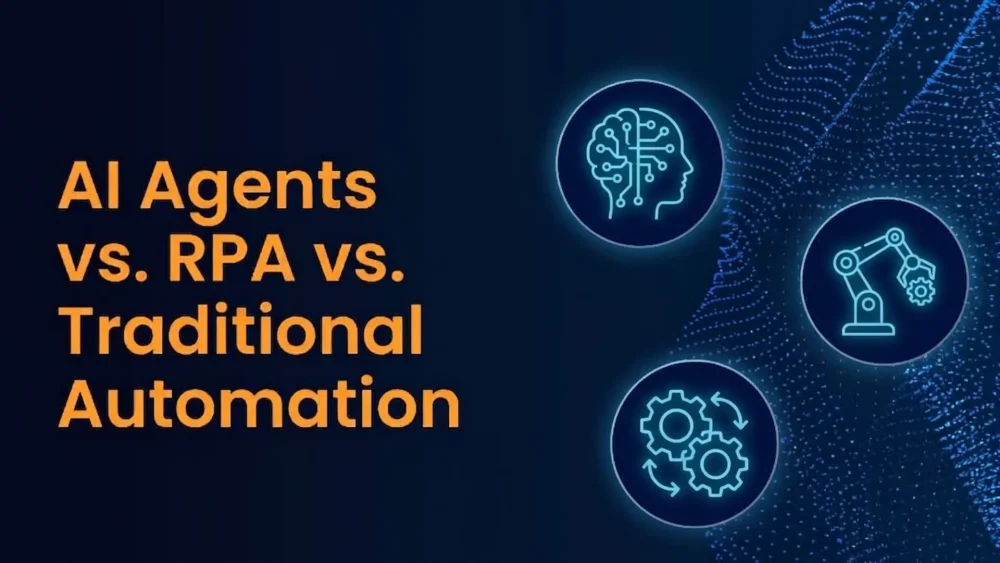
- Traditional automation runs fixed scripts, RPA mimics human clicks on rule-based tasks, and AI agents reason through unstructured input and adapt when the process branches.
- The three are not interchangeable. Most automation failures come from picking the wrong one for the process, not from bad execution.
- RPA still wins on structured, high-volume, low-variance tasks where a rule never changes.
- AI agents earn their cost when a process involves judgment, unstructured data, or exceptions that used to route to a human.
- The mistake founders are already repeating: deploying agents the way teams over-deployed RPA bots, without governance, and ending up with a maintenance problem instead of an efficiency gain.
Most founders don’t start with the question “RPA vs AI agent.” They start with a process that’s eating hours every week and a vendor pitch that tells them the answer is whichever one that vendor sells. That’s how a company ends up paying for an AI agent to do work a fifteen-dollar RPA license could have handled, or stretching a rule-based bot across a task it was never built for and watching it break every time a supplier changes an invoice format.
The cost of getting this wrong isn’t just wasted budget. It’s a re-architecture six months in, a process nobody trusts because it silently failed on an edge case, or a team that goes back to doing the work manually because the automation created more exceptions than it resolved.
This is a decision with a right answer, and it depends on the shape of the process, not the sophistication of the tool. Here’s how to make that call before you commit engineering time or a vendor contract to it.
What traditional automation and RPA actually do, and where they stop
Traditional automation is the oldest of the three: scripts, macros, and scheduled jobs that execute a fixed sequence of steps. Nothing interprets, nothing decides. If the input format changes, the script breaks. It’s cheap, predictable, and still the right tool for a huge share of backend work like nightly batch jobs, file transfers, and report generation.
Robotic Process Automation (RPA) sits one layer up. RPA bots mimic what a human does at a keyboard: log into a system, copy a field, paste it into another system, click submit. They follow rules, not judgment. A bot processing invoices knows to pull the amount from field 4 and the vendor name from field 2, every time, because that’s what it was configured to do.
That’s also RPA’s ceiling. The moment a process needs a bot to notice that field 4 sometimes holds a discount code instead of a total, or to decide which of three approval paths an unusual request should take, RPA needs a human to step in or the whole run fails.
Middle East businesses have adopted RPA at real scale for exactly this reason. It’s cheap to license, fast to deploy against a well-documented process, and government-backed digital transformation programs across the UAE and Saudi Arabia have pushed adoption hard. Competenza has written about where RPA fits and why regional businesses are adopting it in more depth, and the short version holds: RPA earns its cost when the rules never change.
What AI agents do differently, and why "smarter RPA" undersells it
An AI agent doesn’t follow a fixed script. It takes an instruction, reasons over context, decides what to do next, and can act across multiple systems without a human specifying every step in advance. Where an RPA bot needs a rule for every branch, an agent can read an unstructured document, extract what matters, and make a judgment call about what happens with it.
The clearest way to see the difference is in a real build. When Competenza worked with JustLogin, a Singapore-based HR and payroll platform, the first phase was a standard bespoke web application. The second phase is where the automation question mattered: JustLogin’s leave approvals, payroll processing, and expense workflows required multi-step handoffs that a rules engine could route, but couldn’t reason through. Competenza built agentic workflow automation that handles those handoffs directly, plus a generative AI assistant covering 17 employee self-service capabilities and AI-driven resume parsing and candidate scoring for recruitment. None of that is achievable with a rule-based bot, because the inputs (a resume, a leave request with context, a candidate’s answers) aren’t structured the way RPA needs them to be.
A similar pattern shows up at SiFi, a Saudi Arabia-based expense management platform scaling from a few hundred users to 5,000+ business customers. Manual receipt matching was the bottleneck. Competenza’s engineering pod contributed to Musa’ed AI, an automation layer that does OCR and document AI on receipts, matches them to transactions with confidence-scored recommendations, and extracts merchant, VAT, and line-item data automatically. A receipt is unstructured by nature: different formats, different languages, different layouts. That’s an AI agent problem, not an RPA problem.
AI agents vs. RPA vs. traditional automation: the actual differences

The mistake founders are already repeating: agent sprawl without governance
Here’s what most comparisons of RPA and AI agents miss entirely: the two have the same failure mode at scale, and it isn’t a technology problem.
Forrester’s research on this is direct: organizations that scaled RPA without governance ended up with an unmanageable number of bots, overlapping functions, and maintenance costs nobody had budgeted for. The same pattern is starting to show up with AI agents, faster, because agents are easier to spin up than a scripted bot ever was. A team deploys an agent to mask a broken process instead of fixing it, another team deploys a second agent that overlaps with the first, and six months later nobody can say which agent owns which decision.
The fix isn’t caution about adopting agents. It’s the same discipline that should have applied to RPA from the start: identify the actual problem before deciding whether the answer is an agent, a bot, an API, or a fixed process change. If the underlying process is broken (data trapped in a format nothing can read, an approval chain that exists for no current reason) automating it just makes the broken process run faster.
When RPA still wins, when agents win, and when you need both
RPA is still the right call for high-volume, rule-based tasks where the inputs never change shape: invoice data entry against a fixed template, scheduled reconciliation between two systems, form-filling against a known structure. It’s cheaper to license, faster to deploy, and doesn’t need the guardrails an agent does.
AI agents earn their cost when the process involves judgment calls, unstructured input, or handoffs across systems that used to require a person deciding what happens next. Recruitment screening, expense receipt processing, customer support that needs context from three different systems to answer one question. These aren’t places where a rule can be written for every case.
Most real automation roadmaps end up using both. RPA handles the structured, high-volume layer. Agents sit on top, handling the exceptions and judgment calls RPA routes back to a human today. Competenza’s AI agent development work is built around this layered approach: customer support agents, sales and lead qualification agents, and operations agents that work alongside existing RPA and process automation rather than replacing it wholesale.
What it actually costs to get this right
Cost estimates in most comparisons treat RPA and AI agents as competing subscriptions, which misses how the budget actually breaks down. RPA licensing is inexpensive per bot, but maintenance adds up fast once a process has more than a handful of exception paths, often running several dirhams in support for every dirham spent on the license itself. AI agent projects front-load more of the cost into scoping and integration, because an agent needs to be connected to the right systems and given the right guardrails before it can reason over anything.
For a single well-defined agent (one workflow, one or two system integrations) most GCC-based engagements start in the AED 40,000 to AED 90,000 range. A multi-agent build spanning several departments, like the recruitment and HR workflow automation built for JustLogin, scales into six figures depending on integration depth and compliance requirements. RPA deployment against an already-documented process is typically the cheaper starting point, but the maintenance cost curve is what determines the real total over 18 to 24 months, not the initial license fee.
Competenza's take
We’ve built both sides of this decision for clients across the UAE and Saudi Arabia, from the RPA layer processing rule-based transactions to agentic workflows that handle judgment calls RPA can’t. What we’ve consistently found is that the projects that fail aren’t the ones that pick the “wrong” technology, they’re the ones that skip scoping the actual process before building anything. Agentic workflow automation only earns its cost when it’s connected to real data and given clear boundaries on what it can decide versus what still needs a human. If you’re trying to work out which parts of your process need an agent and which are still better served by a rules engine, here’s how we scope that before writing a line of code.
The real question isn't which technology wins
Traditional automation, RPA, and AI agents aren’t competing for the same job. Each one is the right answer for a different shape of process, and the founders who get burned are usually the ones who picked based on what a vendor was selling rather than what their process actually needed.
The practical next step is smaller than it sounds: map the process end to end, mark every point where a human currently makes a judgment call, and check whether that judgment call involves unstructured input. That single exercise tells you more about which technology to use than any comparison article, including this one.
If a process has zero judgment calls and a fixed input format, RPA or traditional automation will do the job for less. If it has even one point where a human is reading something unstructured and deciding what happens next, that’s where an agent starts to pay for itself.
FAQs
How much does an AI agent cost compared to RPA?
RPA licensing is cheaper upfront, often a few hundred dollars per bot per month, but maintenance costs climb as exception paths accumulate. A single, well-scoped AI agent typically starts around AED 40,000 to 90,000 for GCC-based engagements, with multi-agent or multi-department builds running into six figures. The real comparison isn’t the sticker price, it’s the 18 to 24 month total including maintenance
Can RPA and AI agents work together in the same process?
Yes, and for most mid-size and enterprise processes, this is the more realistic setup than choosing one exclusively. RPA handles the high-volume, rule-based steps. An agent sits on top to handle the exceptions, unstructured inputs, and judgment calls that used to route back to a person.
What's the biggest risk in deploying AI agents at scale?
Governance, not capability. Organizations that scale AI agents the way they scaled RPA bots, without clear ownership of which agent handles which decision, end up with overlapping functions and rising maintenance costs. The fix is treating agent deployment as an orchestration problem from day one, not adding agents one at a time without a map of how they interact.
How do I know if my process needs RPA or an AI agent?
Map the process and find every point where a human currently makes a judgment call or reads unstructured input (a resume, a receipt, a free-text support ticket). If there are none, RPA or traditional automation will handle it for less. If there’s even one, that’s where an agent starts to earn its cost.
What makes Competenza different from other automation providers in the GCC?
Most regional providers sell either RPA or AI development, not both under one roof with the same delivery team. Competenza has built rule-based automation and agentic workflows for the same clients (JustLogin’s agentic HR workflows and SiFi’s Musa’ed AI receipt processing are both live examples) which means the recommendation on RPA versus agents isn’t shaped by which product a sales team is trying to move.
Do AI agents replace RPA entirely?
No. RPA remains the more efficient choice for fixed, high-volume, rule-based tasks. Agents are built for the judgment-based and unstructured-input work that RPA was never designed to handle. Most mature automation strategies run both.