TL;DR
- Saudi Arabia’s data center capacity grew nearly sevenfold between 2021 and early 2026, and the Kingdom’s Cabinet designated 2026 the “Year of AI.”
- The Public Investment Fund has committed more than $40 billion to AI and digital infrastructure, part of a broader push that put Saudi Arabia in the World Bank’s top 10 countries for private AI investment.
- For Saudi businesses, this Vision 2030 technology investment wave changes procurement, compliance expectations, and vendor selection, not just the macro numbers investors watch.
- Custom software aligned with ZATCA, SAMA, and Saudi PDPL requirements typically runs SAR 150,000 to SAR 3,500,000+, depending on scope and regulatory depth.
- The investment story has a genuine risk side too: talent competition, market maturity gaps, and regulation still catching up to the pace of funding.
Introduction
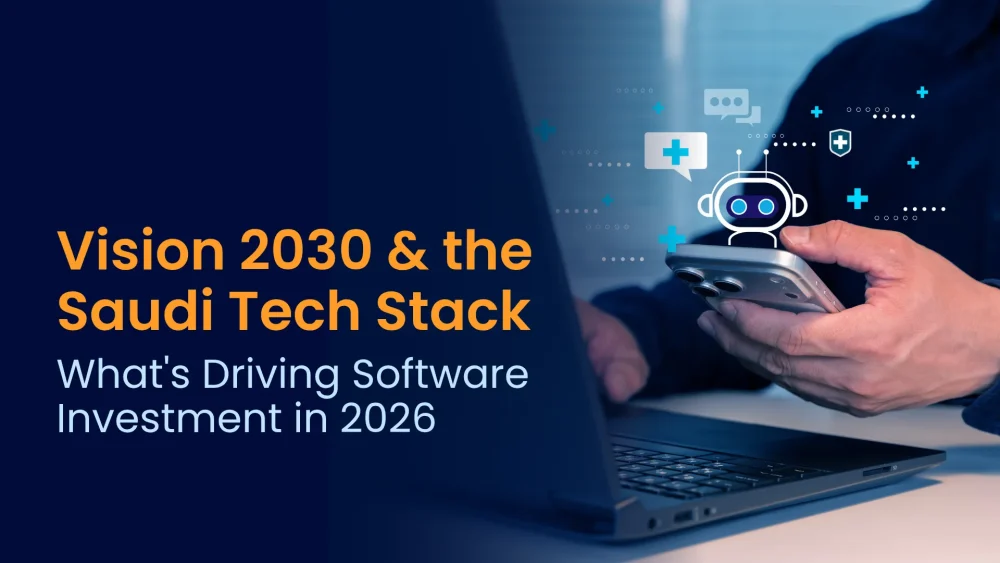
Vision 2030 technology investment has a headline number attached to almost every announcement this year. Saudi Arabia’s data center capacity grew almost sevenfold in five years, from 68 megawatts in 2021 to more than 467 megawatts by the first quarter of 2026. In March 2026, the Cabinet designated 2026 the Kingdom’s “Year of AI”. The Public Investment Fund has committed more than $40 billion to AI and digital infrastructure alone.
These aren’t just abstract headlines for Saudi business leaders. They represent a shift in how software gets funded, regulated, and procured across the Kingdom. If you’re a CEO or CTO weighing whether now is the moment to invest in a new platform, the numbers matter less on their own than what they mean for your specific build, your compliance timeline, and your vendor shortlist.
Why 2026 Is Saudi Arabia's “Year of AI”
The Cabinet’s Year of AI designation wasn’t a marketing label. It followed the World Bank’s 2026 World Development Report placing Saudi Arabia among the top 10 countries globally for private AI investment, citing the Kingdom’s tax incentives, special economic zones, and rapid data center buildout as evidence of a coordinated national push rather than isolated project spending.
The scale is unusual even by Gulf standards. PIF has allocated a dedicated AI and digital infrastructure fund exceeding $40 billion, distributed across physical infrastructure, compute hardware, and applied AI development. HUMAIN, launched under PIF and chaired by the Crown Prince, is building a full AI ecosystem spanning data centers, cloud, models, and applications.
Government technology spending rose more than 56 percent in 2024, and AI-focused companies operating in the Kingdom attracted $9.1 billion in funding that same year. None of this is speculative pipeline. Fourth and fifth generation network coverage reached 99 percent by the end of 2025, giving the infrastructure a real base to build on rather than a plan waiting on connectivity.
What Vision 2030 Is Actually Funding: A Sector Breakdown
Vision 2030’s digital economy mandate spans more ground than the AI headlines suggest. The Communications, Space and Technology Commission and the Saudi Data and Artificial Intelligence Authority (SDAIA) set policy, while the Ministry of Communications and Information Technology coordinates delivery across five sectors that matter directly to software buyers:
Cloud computing and data centers: Saudi Arabia’s data localisation requirements have pulled hyperscale operators including Oracle, Google Cloud, and Alibaba Cloud into the Kingdom, each establishing local regions. The Cloud Computing Special Economic Zone in Riyadh adds further incentives for qualifying operators.
Artificial intelligence: SDAIA’s national strategy positions AI development for government services, Arabic-language natural language processing, computer vision for industrial and security use cases, and AI-enabled healthcare diagnostics as priority areas, backed by strong government demand and institutional support.
Cybersecurity: The National Cybersecurity Authority mandates standards across government and critical infrastructure. Every digitalisation initiative under Vision 2030 widens the attack surface it’s meant to secure, which is driving parallel demand for threat detection, identity management, and compliance auditing services.
E-commerce: The Kingdom’s e-commerce market is the largest in the Middle East, governed by an E-Commerce Law covering disclosure, consumer rights, and electronic contracts. Payment infrastructure built around Mada and HyperPay already carries the majority of Saudi online transactions, and Vision 2030 originally targeted lifting e-commerce’s share of retail from roughly 20 percent to 80 percent, a gap that still represents significant build demand.
Smart cities: NEOM and the other giga-projects create demand for IoT networks, traffic and energy management platforms, and digital twin modeling that most enterprise software vendors have never had to build for at this scale.
What This Means for Saudi Businesses Building Software Right Now
For most Saudi CEOs and CTOs, Vision 2030 technology investment changes three things: who you’re competing against for talent, what compliance now gets scoped in from day one instead of bolted on later, and how government-adjacent capital shows up in your own market.
That last point is easy to underestimate. SiFi, a Riyadh-based spend management platform backed by PIF’s Sanabil Investments, needed ZATCA e-invoicing, SAMA CSF, and Saudi PDPL built into its architecture from the first release, not retrofitted once the platform hit scale.
Competenza worked as SiFi’s dedicated product engineering team through that build and the platform’s later AI layer, Musa’ed AI, which now handles receipt understanding and transaction matching for a platform serving 5,000-plus business customers.
That pattern, PIF-adjacent capital funding a platform that had to be compliance-first from day one, is becoming the norm rather than the exception. If your business plan touches government procurement, SAMA-regulated payment flows, or data governed by SDAIA’s frameworks, the compliance requirements aren’t optional add-ons anymore. They’re architecture decisions that determine which vendors can actually deliver, whether you’re a funded startup building your first platform or an enterprise modernising one.
What a Vision 2030-Aligned Software Project Actually Costs
Cost estimates for “AI-powered” or “Vision 2030-ready” software vary wildly online, mostly because most guides skip the compliance layer that drives the real spread. The table below anchors cost to project type and regulatory depth, in Saudi riyals.

Quick reference — what adds cost fastest:
- Adding a second compliance framework typically adds 20–35% to a base build
- SAMA-regulated payment flows require sandbox testing before production, adding time and cost
- Multi-entity architecture (needed for group companies) is a day-one design decision, not a later add-on
Before scoping a project, four questions separate a realistic budget from a surprise mid-build change order:
- Does the platform need to handle SAMA-regulated payment flows, or only report on them?
- Is ZATCA e-invoicing a launch requirement or a phase-two addition?
- Will Saudi PDPL data localisation apply to your full dataset or a subset?
- Does your approval or workflow logic already exist on paper, or will it need to be mapped during discovery?
For a deeper breakdown of what these requirements mean in practice, see our Saudi Arabia compliance requirements guide.
The Honest Risk Side to Vision 2030: What the Headlines Leave Out
The investment numbers are real, but so are the friction points that rarely make it into the PR coverage. A useful evaluation weighs both.
Talent competition is intense: Demand for Saudi technology talent has created a real salary inflation and retention pressure, and companies now need to offer more than compensation to hold onto engineering teams mid-project.
Market maturity still lags established hubs: Enterprise sales cycles in the Kingdom can run longer than in mature technology markets, and customer sophistication varies significantly across sectors, which affects both go-to-market timing and vendor selection.
Not every announcement survives contact with realit: LEAP 2026, the Kingdom’s flagship technology conference, was postponed this year, a reminder that even headline-grabbing initiatives can slip on execution timelines.
Regulation is still catching up: SDAIA’s AI governance framework and Saudi PDPL are both evolving, and compliance requirements that are optional today may become mandatory procurement criteria within a single budget cycle.
None of this actually undercuts the scale of what’s happening. It does mean a vendor who treats compliance as a feature to add later, rather than an architecture decision to make on day one, is building on assumptions that may not hold for long.
The pattern shows up before the compliance conversation even starts. Most Saudi enterprises reach the custom development conversation after a SaaS tool has already failed them, not because the interface was wrong, but because it was built for a workflow, and a regulatory environment, that isn’t Saudi Arabia’s. That’s where working with a competent partner like Competenza can save so much trouble.
Competenza has delivered software across healthcare, fintech, logistics, retail, and construction for teams in the UAE, Saudi Arabia, Kuwait, Qatar, and Bahrain, work verified by a 5/5 Clutch rating and ISO 27001 certification across 750-plus organisations. That range matters here because the compliance-first lesson isn’t specific to spend management. On SiFi, it meant scoping SAMA CSF and ZATCA into the data model before the first screen was designed. On a healthcare platform, it’s NPHIES and SFDA. On a logistics build, it’s data residency and cross-border transfer rules. The regulator changes by sector, but the sequencing doesn’t.
That sequencing is what changes as Vision 2030 funding accelerates procurement cycles across every one of these sectors at once. The platforms that survive their first regulatory audit are the ones where the mapping happened on day one, whatever the platform is built to do.
Conclusion
The Vision 2030 investment numbers will keep making headlines through 2026, and most of them will keep describing money at the sovereign fund and infrastructure level. The decision in front of most Saudi CEOs and CTOs is smaller and more concrete: whether the platform you’re about to scope is built to survive a SAMA audit or a ZATCA review, or whether that gets figured out after launch.
FAQs
How much does compliant software development cost in Saudi Arabia in 2026?
Costs typically range from SAR 50,000 for a single-framework MVP to SAR 3,500,00 or more for a full-scale regulated platform, with the largest cost driver being how many compliance frameworks (ZATCA, SAMA CSF, Saudi PDPL) the platform needs to satisfy at launch.
What is SDAIA and why does it matter for software projects?
The Saudi Data and Artificial Intelligence Authority (SDAIA) sets national AI strategy and administers Saudi PDPL, the Kingdom’s data protection law. Any platform processing personal data or deploying AI features in Saudi Arabia needs to account for SDAIA’s governance requirements from the design stage.
Is Vision 2030 tech investment mostly government spending, or is private sector demand growing too?
Both. PIF-linked capital anchors the largest infrastructure bets, but private venture funding is growing fast alongside it. Fintech alone accounted for 67 percent of Saudi venture capital deployed in the first half of 2026, up from 28 percent across all of 2025.
Should a business time its software investment around Vision 2030 funding cycles?
Funding availability shouldn’t drive build timing on its own. The more reliable signal is whether your compliance requirements (SAMA, ZATCA, Saudi PDPL) are stable enough to architect around now, or whether waiting for regulatory clarity on a specific requirement makes more sense before committing budget.