TL;DR
- SaaS application development means building cloud-hosted, subscription software that customers reach through a browser or app, with no local install.
- UAE businesses are moving to SaaS for lower upfront cost, faster time to value, and easier scaling across Dubai and Abu Dhabi.
- A typical UAE SaaS build runs from AED 150,000 for a lean MVP to AED 250,000 to 500,000 for a multi-tenant platform, and from AED 250,000 once AI features are involved.
- The builds that scale get PDPL-aligned data handling, tenant isolation, and a real billing engine right from the first sprint, not after the first enterprise buyer asks for proof.
- This is where the right SaaS Application Development Agency can be your best friend.
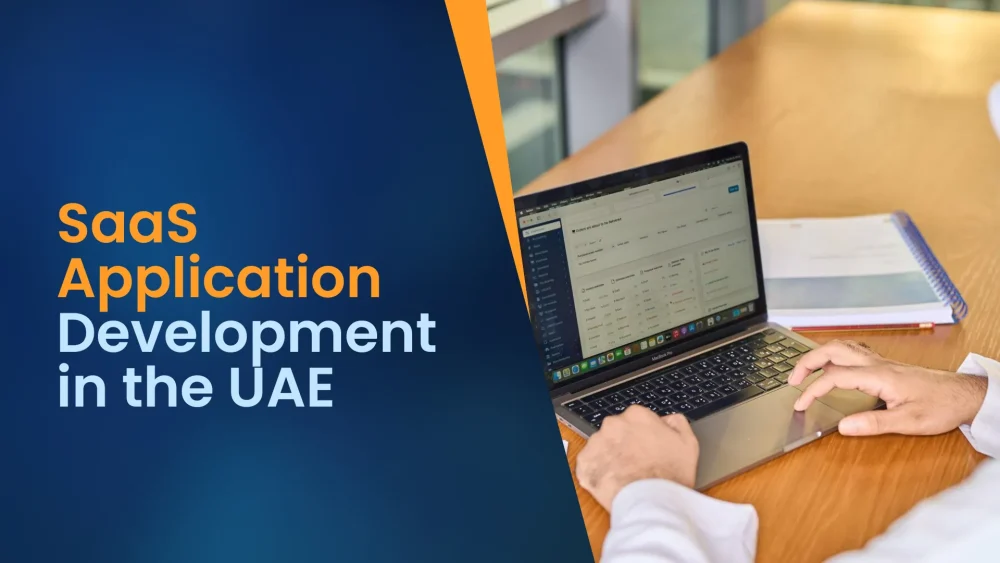
SaaS application development is the process of building cloud-hosted software that customers reach through a browser or app, paying a recurring fee instead of a one-time licence. In the UAE, that shift is no longer optional for most founders. Dubai and Abu Dhabi buyers now expect subscription software that updates itself, scales without a server migration, and holds up under UAE data protection rules. By the end of this guide, you will know what a UAE-ready SaaS build actually costs, and what separates one that scales cleanly from one that stalls at MVP.
What is a SaaS product?
A SaaS product is software that lives on the vendor’s servers and reaches users over the internet, usually through a browser or a lightweight app. Nobody installs anything locally, and nobody runs a server room to keep it available.
The vendor handles hosting, security patching, and version updates. The customer logs in, pays a subscription, and uses the product.
Familiar examples include CRM platforms, HR and payroll systems, accounting software, and project management tools. In the UAE, this model now covers everything from clinic scheduling software to freight tracking dashboards and digital lending platforms.
SaaS is not just a hosting choice, it is a different business model. Recurring billing, tenant onboarding, usage tracking, and customer support all need to be designed into the product from day one, not bolted on after launch.
This distinction matters most at the point of sale. A one-time software licence closes a single deal. A SaaS subscription only pays back once a customer stays long enough to justify the cost of acquiring them, which is why retention and onboarding get as much engineering attention as the core feature set.
Why Businesses keep Investing in SaaS Products in the UAE
UAE businesses are shifting budget from one-time software purchases to subscription platforms for four connected reasons.
Lower upfront cost: A SaaS product removes the need to buy servers, license software per seat, or hire an in-house team just to keep systems running.
Faster time to value: Cloud-native platforms deploy in weeks, not the months a traditional on-premise rollout usually takes.
Built-in scalability: A properly built multi-tenant SaaS platform absorbs new customers as an infrastructure task, not a product rebuild.
Compliance pressure: UAE data protection rules push buyers toward platforms that can prove where data sits and who can access it, something legacy on-premise systems were rarely built to demonstrate.
Dubai and Abu Dhabi’s ongoing push toward cloud-first government and enterprise IT has accelerated all four. Founders building SaaS products for the UAE market increasingly compete on compliance depth and integration fit, not just feature lists. The hidden costs of running global SaaS tools in the Middle East are a useful place to see what happens when that fit is missing.
A number of UAE buyers have also learned this the hard way. Teams that adopted an international SaaS tool without local payment support or PDPL-aligned data handling often end up paying twice: once for the subscription, and again in engineering hours spent building workarounds around the gaps. That pattern is a large part of why locally built or GCC-aware SaaS platforms are gaining ground against global incumbents in the UAE market.
Core Components of SaaS Development
Every SaaS product, regardless of industry, rests on the same core layers.
The presentation layer is what the user sees: the web app, the dashboard, and the mobile companion app if there is one.
The application layer holds the business logic: onboarding rules, permissions, notification triggers, and workflow logic specific to the product.
The database layer stores data with tenant isolation built in, so one customer’s records never surface in another customer’s view.
The API layer sits between the product and the outside world, handling authentication, rate limiting, and integrations with third-party tools such as accounting software or a CRM.
The multi-tenancy layer decides how customer data is separated: a shared database, an isolated schema per tenant, or a fully isolated database for customers who require it.
The billing and subscription engine handles recurring charges, plan upgrades, VAT calculation, and failed payment retries. This layer gets underestimated more than any other, and it is usually the first thing that breaks under real usage.
The security layer cuts across all of the above: encryption at rest and in transit, access control, audit logging, and secrets management.
None of these layers work in isolation. A tenancy decision made in the database layer shapes what the API layer needs to enforce, which in turn shapes how much the security layer has to check on every request. Getting the sequence of decisions right at the start is what separates a SaaS product that scales cleanly from one that needs a rebuild at its first hundred customers.
Types of SaaS Development Services
SaaS development is not a single service. Founders typically need one of the following, sometimes in sequence. Competenza’s SaaS development services span all six categories below for UAE and GCC clients:
Full SaaS product development covers the entire build, from architecture to launch, for a founder starting from an idea or a written spec.
MVP development narrows the scope to one workflow, built well enough to put in front of paying customers without the full feature set.
Platform modernisation applies to businesses moving an existing on-premise or legacy system into a cloud-based, subscription-ready product.
Vertical SaaS development builds for a specific industry: fintech platforms aligned with CBUAE requirements, logistics SaaS for fleet and warehouse operations, or HR and payroll SaaS with regional payroll rules built in.
AI-enabled SaaS development adds a named capability on top of the core product: document processing, a support chatbot, demand forecasting, or an analytics layer that flags anomalies before a human would catch them.
Ongoing maintenance and support keeps a live SaaS product patched, monitored, and evolving after launch, which is where most of a SaaS product’s total lifetime cost is actually spent.
Vertical SaaS or Horizontal SaaS?
A horizontal SaaS product, such as a general project management tool, serves many industries with one flexible feature set. A vertical SaaS product, such as a clinic scheduling platform or a freight management system, serves one industry deeply and bakes that industry’s rules into the product itself.
Vertical SaaS usually wins faster trust in the UAE market because it already speaks the buyer’s language: the right compliance fields, the right integrations, and the right workflow assumptions, without the buyer having to configure them from scratch.
Benefits of Professional SaaS Development Services
Bringing in a professional SaaS development team changes three things: speed, risk, and total cost.
Speed: Teams that have already built multi-tenant platforms do not spend the first two months relearning architecture decisions. They arrive with patterns already tested.
Risk: Security gaps, VAT logic errors, and tenant isolation mistakes are expensive to fix after launch. A team that has handled UAE compliance requirements before catches these at the design stage, not in a client audit.
Cost predictability: Hiring a full in-house team before validating demand is a fixed cost regardless of whether the product succeeds. A development partner scales the engagement with the project instead.
Neither path is universally right. A founder validating an idea usually gets there faster with a partner. A company running SaaS as its core, long-term product may build the case for an in-house team once the roadmap stabilises. This breakdown of how to evaluate SaaS development companies in Abu Dhabi is a useful reference either way.
In-House vs. Outsourced SaaS Development: A Quick Comparison

SaaS Application Development Complete Process
- Discovery and validation: Confirm the problem is real and someone will pay to have it solved, before writing a line of code.
- UI/UX design: Wireframes and prototypes map the one workflow an MVP needs to nail, tested with a handful of real users before full development starts.
- Architecture and tech stack: Decide the multi-tenancy model, cloud provider, and database structure. These decisions are far cheaper to get right now than to redo after launch.
- Backend and frontend development: Build the application logic, APIs, and user-facing screens in parallel sprints, with the billing engine treated as a core feature, not an afterthought.
- Compliance and security: Bake in PDPL-aligned data handling, encryption, and access controls rather than retrofitting them once an enterprise buyer asks for documentation.
- Testing and QA: Functional, performance, and security testing across devices, plus load testing before the first real customer cohort arrives.
- Deployment and scaling: Ship to a small, specific audience first. Scale infrastructure in response to actual usage, not projected usage.
Why You Should Build a SaaS Product
A SaaS product changes the economics of a software business in four ways.
Recurring revenue: Customers pay monthly or annually instead of once, which makes revenue predictable and easier to forecast against.
Reach without local offices: A browser-based product serves customers across Dubai, Abu Dhabi, and beyond without opening a branch in each city.
Compounding product data: Every login and workflow generates usage data that shows exactly where customers get stuck, which shortens the distance between a support ticket and a fix.
Scaling as an infrastructure problem, not a rebuild: Onboarding customer 200 should look like provisioning resources, not rewriting the product.
Product-led distribution: A free trial or a freemium tier lets the product sell itself to the next department or the next branch, which matters in a region where referrals carry more weight than cold outreach.
The tradeoff is real. SaaS products need continuous investment in support, security, and retention long after launch. Founders who go in expecting a one-time build usually get the economics wrong.
Cost of SaaS Development in UAE
SaaS development cost in the UAE depends on scope, not a fixed formula. As a starting reference:

Timelines track cost. A lean MVP typically ships in 8 to 12 weeks. A multi-tenant platform with a full billing engine and compliance controls usually needs 3 to 6 months. An AI-integrated build adds further time depending on how much custom model work is involved versus wrapping an existing API.
Four factors move a project up or down within these ranges: how many third-party integrations are required, such as payment gateways, ERPs, or CRMs; how deep the compliance requirement runs; whether the tenancy model is shared, schema-isolated, or fully isolated; and how much of the AI layer is genuinely custom versus a wrapped third-party API.
Ongoing costs stack on top of the build: cloud hosting, monitoring, third-party API fees, and a maintenance retainer that most teams underestimate by treating it as optional rather than structural. Our full GCC SaaS strategy and cost breakdown covers tenancy, VAT logic, and hosting decisions in more depth if you are scoping a build across UAE and Saudi Arabia together.
A Practitioner's View
Most SaaS builds we see in the UAE do not fail on features. They fail on the parts nobody demos: tenant isolation done properly, a billing engine that survives a VAT audit, and compliance documentation ready before a buyer asks for it.
At Competenza, our SaaS development services are built around multi-tenant architecture, subscription billing, and PDPL-aligned data controls from the first sprint, not retrofitted after a client’s first enterprise prospect asks hard questions. Our work on JustLogin, an HR and payroll SaaS platform now running across 3,000+ businesses in 20+ countries, shows what that discipline looks like at scale: an Angular and .NET foundation built to carry a GenAI layer on top later, not a rebuild to bolt one on.
Ten years of building for the GCC has taught us one thing: architecture decisions made in week one either save or cost a company its next funding round.
Conclusion
SaaS application development in the UAE rewards founders who treat architecture, compliance, and billing as day-one decisions rather than launch-week fixes. The core process does not change much by industry. What changes is how much UAE-specific compliance and payment work sits underneath a build that is genuinely ready for this market, compared with a generic international one.
FAQs
What is SaaS application development?
SaaS application development is the process of designing, building, and maintaining cloud-hosted software that customers access through a browser or app on a subscription basis. It covers everything from the first architecture decision to ongoing maintenance after launch.
Is ChatGPT a SaaS?
Yes. ChatGPT is delivered as a SaaS product: users access it through a browser or app on a subscription tier, with no local install and no infrastructure to manage. The underlying AI model is the technology inside the product, but what people actually use is a SaaS application built on top of it.
What skills are needed for SaaS?
Building a SaaS product needs full-stack engineering, cloud architecture, and database design as a baseline. Beyond that, teams need security and compliance knowledge for the markets they serve, UX design for the core workflows, DevOps for deployment and monitoring, and product management to keep the roadmap tied to what customers actually use.
What is SaaS vs API?
SaaS is a complete hosted application with a user interface that a customer logs into and uses directly. An API is a way for one piece of software to talk to another, usually with no interface at all. Most SaaS products expose an API so other tools can connect to them, but an API on its own is not a SaaS product.