TL;DR
Choosing a WMS developer in the UAE is not just about features. This guide compares the leading agencies, explains when custom development is required, and highlights the compliance, integration, and multi-site challenges common in UAE warehouse projects.
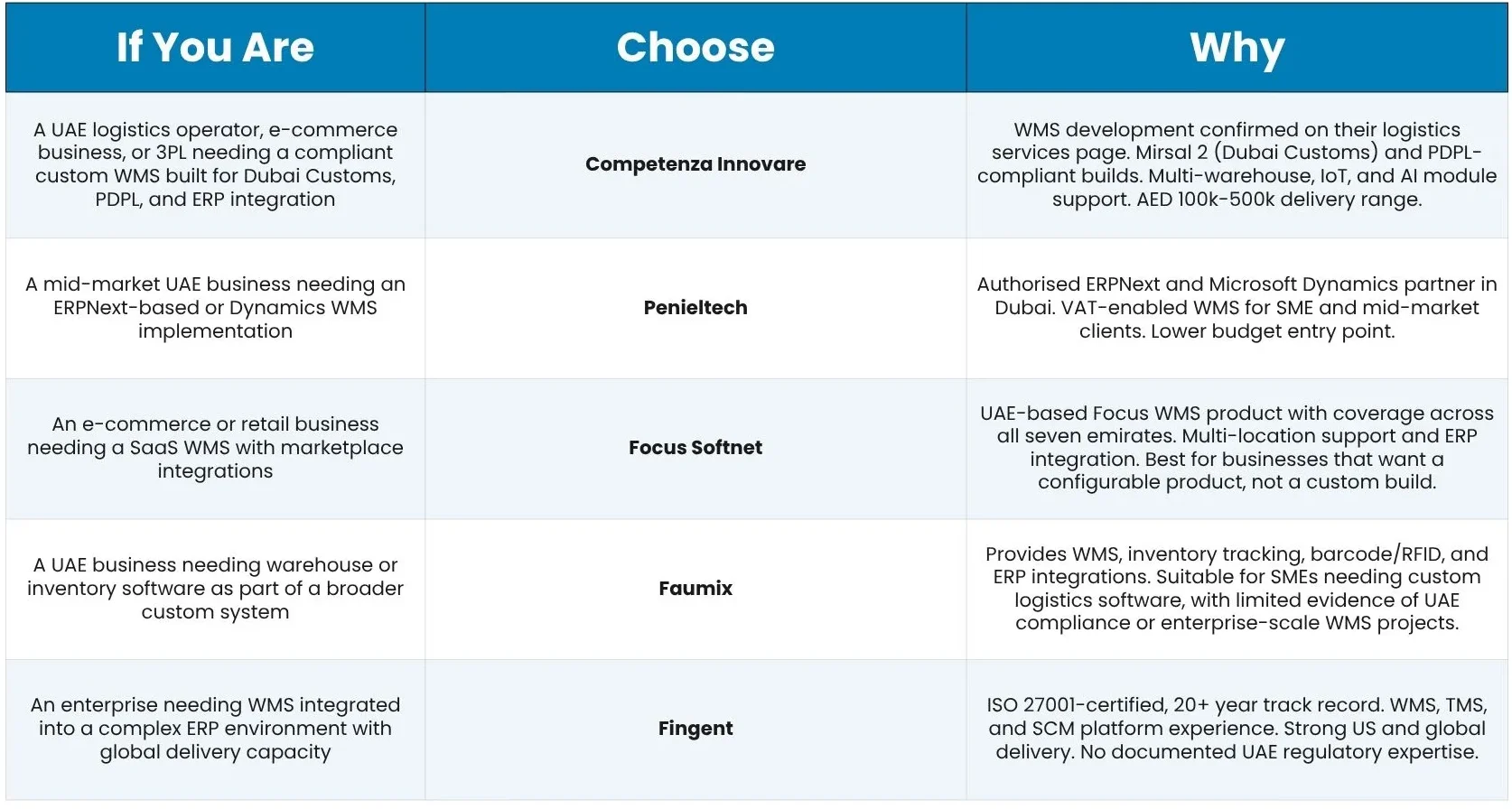
Before going into detailed reviews, here is a quick way to narrow your options. Match your use case with the type of WMS you need, then see which agency is best suited for that kind of project.
Introduction
Picture this: your warehouse team is managing inventory across three Dubai locations using a mix of Excel sheets, WhatsApp groups, and a legacy ERP that was never built for real-time stock visibility. Orders go out late. Stock counts are wrong by the time the data reaches the system. And when Ramadan peak hits, the whole operation shows exactly where the cracks are.
This happens due to problems in system. And it is more common in UAE logistics operations than most supply chain managers want to admit.
The UAE’s logistics sector is growing fast. Dubai’s position as a global trade hub, the expansion of free zones like JAFZA and DAFZA, and the surge in e-commerce all mean that warehouse operations are under more pressure than ever. Off-the-shelf WMS tools exist for this market, but most were not built for Mirsal 2 customs integration, PDPL data handling requirements, or the multi-tenant warehouse structures that 3PL operators in the UAE actually run.
This guide is for logistics operators, supply chain managers, and e-commerce businesses evaluating which development agency in the UAE can build a WMS that works for their operation. We cover what separates a custom WMS from a software product, the UAE-specific compliance requirements, and which agencies have the verified capability to deliver. Let’s get into it.
Before choosing a development partner, the first question most warehouse operators ask is whether they actually need a custom WMS at all, or if an off-the-shelf product can handle their operation.
Off-the-shelf WMS vs. custom WMS: when does custom actually make sense?
Most warehouse operations in the UAE start with a software product. Focus on WMS, NetSuite, SAP WMS, or a module inside their existing ERP. Some of those implementations work well. Many hit a wall within 18 months when the operation outgrows the configuration options the product allows.
The decision point is not about the budget. It is about fit. Three situations reliably push businesses toward custom development.
- First, the operation has workflows that no off-the-shelf tool supports without a significant manual workaround. Multi-client 3PL billing, bonded warehouse handling inside Dubai Customs free zones, or temperature-controlled storage with IoT monitoring are all examples. Generic products offer these as add-ons or not at all.
- Second, the system needs to integrate deeply with an existing ERP, marketplace, or last-mile logistics platform, and the available connectors do not cover the required data flows. A custom integration built around your actual data model is faster and more reliable than mapping between mismatched API schemas.
- Third, the business operates across multiple locations in the UAE and needs a single platform with location-level visibility, user permissions, and reporting. Most mid-market WMS products charge per warehouse or per user in ways that make multi-site deployments expensive at scale.
In the UAE, a custom WMS is not just about flexibility. It has to support customs integration, multi-warehouse visibility, compliance rules, and hardware used on the warehouse floor. That changes what the system must include.
The right test for whether you need custom development is simple: ask your current WMS vendor to show you how the system handles your most complex warehouse exception. If the answer involves a workaround, a manual step, or ‘we can look at that in the next release,’ you have your answer.
Key features to expect from a custom WMS built for UAE operations
A production-ready WMS for UAE logistics operations covers more ground than inventory tracking and order picking. Here is what a well-built custom system includes, and why each module matters for operations in this market specifically.

Read this guide to know the cost involved in building the logistics software in UAE.
The two modules most UAE warehouse operations underspecify at the briefing stage are Mirsal 2 integration and PDPL-compliant data handling. Both feel like IT requirements rather than business requirements. Both create serious problems at go-live if they were not designed in from the start. Competenza’s pre-development discovery sprint specifically surfaces these before any architecture is drawn.
How we evaluated these agencies
This shortlist focuses on custom WMS development for UAE logistics operations. Not general app development. Not off-the-shelf WMS products. Every agency listed here has demonstrated relevant capability through their published services, portfolio, client reviews, or regulatory knowledge. We evaluated five criteria:
- WMS or logistics software development track record in the UAE or GCC
- UAE compliance knowledge: Mirsal 2, PDPL, VAT, free zone regulations
- ERP and third-party integration capability
- Client reviews on Clutch, GoodFirms, or Google with verified project evidence
- Engineering maturity: certifications, team size, post-launch support model
We did not include general mobile app developers, SaaS WMS product vendors, or agencies without documented UAE logistics experience.
Best WMS development agencies in the UAE

1. Competenza Innovare

Competenza Innovare provides custom warehouse management system development in the UAE for logistics companies, e-commerce operators, distributors, and 3PL providers that need more than a configurable WMS product. Their WMS builds focus on real-time inventory visibility, multi-warehouse operations, ERP integration, and compliance requirements common in Dubai and other GCC logistics hubs.
Why differentiate Competenza from others in the list is their ability to deliver architecture first custom WMS built for UAE logistics companies.
Why we shortlisted Competenza
We shortlisted Competenza as they position WMS as an architecture-first custom build, not a configured product. They design the system around the client’s warehouse structure, billing model, and integrations instead of forcing the operation to adapt to software limits.

For more on Competenza’s logistics software development work across the UAE and GCC, see their logistics software development services page.
This is what our clients say about us

2. Penieltech

Penieltech is a Dubai-based software solutions provider and authorised partner for ERPNext and Microsoft Dynamics. Their WMS offering, Elate WMS, is built on top of ERPNext and covers inventory management, barcode scanning, purchase orders, stock transfers, and VAT-enabled reporting for UAE businesses.
Why we shortlisted Penieltech
We shortlisted Penieltech because they provide WMS as part of ERPNext and Microsoft Dynamics implementations in the UAE, which suits SMEs needing warehouse control inside an ERP.

3. Focus Softnet

Focus Softnet provides a packaged warehouse management system as part of the Focus ERP product suite, widely used by retail, distribution, and trading companies in the UAE and other GCC markets. The system is designed as a configurable WMS product with built-in modules for inventory tracking, barcode scanning, stock transfers, order fulfilment, and multi-location warehouse control.
Why we shortlisted Focus Softnet
We shortlisted Focus Softnet because it is one of the few WMS products widely used in the UAE and GCC, with clear documentation of warehouse, inventory, and multi-location features inside a packaged ERP system.

4. Faumix

Faumix provides warehouse management system development as part of their custom software services, with features such as inventory tracking, barcode support, reporting, and ERP integration. They position WMS as a custom-built system rather than a packaged product, aimed at businesses that need more flexibility than standard inventory software.
Why we shortlisted Faumix
We shortlisted Faumix because their warehouse management software development include inventory control, barcode/RFID, reporting, and ERP integration, which confirms experience with logistics and inventory software.

5. Fingent

Fingent provides custom warehouse management and supply chain software that offer inventory tracking, warehouse automation, ERP integration, and manufacturing or distribution workflows. They position warehouse systems as larger digital transformation projects rather than as a standalone WMS product.
Why we shortlisted Fingent?
We shortlisted Fingent because of their experience in building warehouse and supply chain software as part of custom enterprise projects

Agency comparison at a glance

How to choose the right WMS development agency for your UAE operation
The shortlist above narrows the field. Here is how to make the final call between the agencies that are a real match for your requirements.
1. Start with your compliance non-negotiables
If your operation runs through a Dubai Customs free zone, imports goods through Jebel Ali, or handles personal data of UAE customers, Mirsal 2 and PDPL compliance are not optional. Ask any agency you are considering to describe their previous experience with both. If the answer involves ‘we can look into that’ rather than a specific project reference, the compliance work will happen on your timeline and your budget.
2. Map your integration requirements before the first meeting
List every system your WMS needs to connect with: ERP, accounting software, e-commerce marketplaces, last-mile carriers, and any hardware (scanners, IoT sensors). Write down what data needs to flow in each direction. Agencies that ask for this document in the first meeting are the ones that have built integrations before. Agencies that start discussing features before they ask about your systems have not.
3. Ask for evidence on multi-warehouse operations specifically
Single-site WMS deployments and multi-site deployments are different problems. If you operate across multiple warehouses in Dubai, Sharjah, or Abu Dhabi, ask to see how the agency has handled stock transfers, location-level permissions, and consolidated reporting across sites in a previous project. A portfolio that only shows single-site builds is a signal.
4. Treat the discovery process as part of the evaluation
The quality of an agency’s discovery process tells you more about their delivery capability than their portfolio does. Competenza runs a scoped discovery sprint before any development begins. Agencies that skip discovery and move straight to quoting features are building on assumptions. In a warehouse system, those assumptions surface as expensive changes six months into the build.
For more on how AI and automation are changing warehouse operations across UAE businesses, see our guide on AI in logistics use cases and benefits for UAE companies.
If you are also evaluating the cost side of this decision, our breakdown of the cost to build logistics software in Dubai covers typical price ranges, scope drivers, and where UAE projects typically over or underspend.
How Competenza Stands out
In many UAE warehouse projects, the problems start long before development. A system needs to talk to Dubai Customs, sync with ERP, handle multiple locations, and still give accurate stock numbers at the end of the day. When those pieces are not mapped early, teams end up fixing things the software should have handled. That is where Competenza’s approach feels different from most vendors in this list.
Competenza begins every project with architecture, integrations, and workflow mapping. They make the list of every system that needs to connect. They define the data flowbefore screens are designed. They begin the discussion with ERP, customs, scanners, user roles, and reporting, not dashboards.
The second difference is the discovery stage. Competenza runs a scoped discovery sprint before development starts. That step forces clarity on warehouse structure, permissions, billing logic, and multi-site reporting.
Competenza has experience working with PDPL requirements, Dubai Customs workflows, and integration-heavy warehouse systems, which points to real UAE logistics projects rather than basic inventory setups. For free-zone warehouses, 3PL operations, or multi-site businesses in Dubai and Abu Dhabi, those details matter more than feature lists.
For a single warehouse with simple stock control, several vendors in this shortlist can work. For multi-site, integration-heavy, or compliance-driven operations, the architecture-first approach used by Competenza is usually the safer path.
This is what our clients say about us

Conclusion
Most warehouse software problems in the UAE start when the system is chosen before the workflows are fully understood. Customs integration, ERP sync, multi-warehouse reporting, and PDPL data handling are often treated as small details. Later they become the reason the system needs workarounds.
The agencies in this list solve different types of projects.
Some sell a WMS product.
Some implement warehouse modules inside ERP.
Some build custom platforms for logistics operations that cannot fit inside packaged software.
The right choice depends on how your warehouse runs today, not on how the demo looks.
Before you speak to any agency, write down three things.
- Your compliance requirements.
- Every system the WMS must connect to.
- How many warehouses the platform must support.
Those answers usually make the decision clear.
If your operation involves multiple sites, free-zone workflows, or heavy integrations, start with a proper discovery instead of jumping straight to development.
It is the fastest way to know whether you need a product, an ERP setup, or a fully custom WMS.
FAQs
What is custom WMS development?
Custom WMS development is the process of building a warehouse management system from scratch, designed around a specific operation’s workflows, compliance requirements, and technology stack, rather than buying and configuring a pre-built software product. For UAE businesses, this typically means building Mirsal 2 customs integration, PDPL-compliant data handling, and Arabic-language UI into the platform from the start. The practical difference from an off-the-shelf product is that the system is built to fit how your warehouse actually runs, including the edge cases and exceptions that generic software forces you to work around manually.
How much does custom WMS development cost in UAE?
How long does it take to build a custom WMS?
A focused WMS covering core inventory management, order fulfilment, and one or two system integrations typically takes four to six months from architecture to go-live. A full enterprise WMS with IoT integration, multi-warehouse management, AI modules, and deep ERP connectivity takes eight to fourteen months. The variable that most teams underestimate is the discovery and requirements phase. Skipping it to save time consistently adds months to the build when requirements surface mid-development.
Can a custom WMS integrate with SAP or Oracle ERP?
Yes, and this is one of the main reasons businesses choose custom development over an off-the-shelf product. A custom WMS can be built with bi-directional API integration with SAP, Oracle, Microsoft Dynamics, or any other ERP, designed around your actual chart of accounts, cost centre structure, and data model. The complexity depends on which SAP or Oracle modules you run and how much custom configuration has been applied to your ERP instance. The agencies on this list with confirmed ERP integration capability are Competenza, Fingent, and Penieltech via ERPNext and Dynamics.
What industries in UAE need custom WMS?
The UAE industries where custom WMS development most often makes sense are: logistics and 3PL (where multi-client billing and Mirsal 2 integration are standard requirements), e-commerce and retail (where marketplace sync, returns processing, and last-mile coordination go beyond what generic products support), food and beverage distribution (where FEFO tracking, temperature monitoring, and expiry management are non-negotiable), pharmaceuticals and healthcare supply chain (where batch tracking, serialisation, and regulatory audit trails are required), and construction and industrial supply (where project-specific stock allocation and multi-site material management do not fit standard warehouse models).