
TL;DR
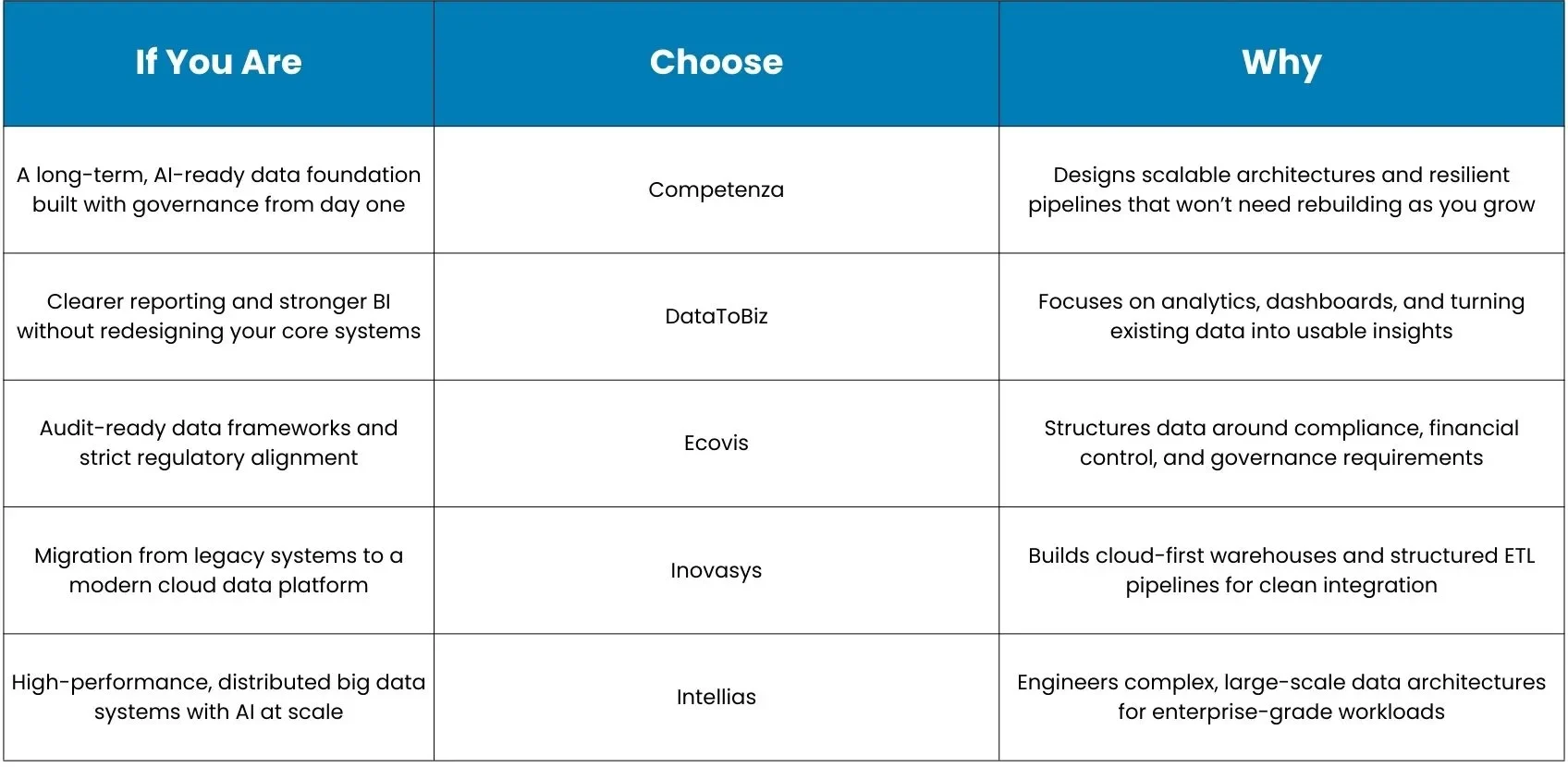
This guide compares leading data engineering service providers in Saudi Arabia so you can avoid shortlisting vendors that appear similar but differ significantly in architectural depth and execution focus.
We shortlisted them based on
- Architectural depth
- Cloud cost control maturity
- Governance integration
- ERP/legacy integration capability
- Delivery ownership
- Long-term scalability planning
Here is a quick summary to quickly identify which company fits your exact data engineering requirements.
Introduction
Selecting the wrong data engineering service provider will cost you much more than not opting for a data engineering service at all.
Choosing the wrong data engineering partner doesn’t just delay a project; it creates architectural debt that’s expensive to fix.
Data engineering is supposed to enable faster decisions, innovations, and compliance while minimizing cost. But any small mistake in choosing the right data engineering partner may lead you to a failed pipeline during peak operations, broken integration between finance and operations, or an unstable cloud data workload that can disrupt decisions that move millions.
And that’s why partnering with the right data engineering company is crucial. But it is rarely as easy as it looks. Because they all appear the same on paper, make the same commitments, and that’s what makes choosing the right data engineering service provider so difficult.
To make this decision easier for you, we have written this guide. It covers the best data engineering service providers in Saudi Arabia with their pros and cons to help you select with clarity, reduce architecture risk.
What is Data Engineering?
Data engineering is the practice of designing and building a system that collects, moves, transforms, stores, and governs data so it can be reliably used for reporting, analytics, and AI.
It connects systems like ERP, CRM, and operational platforms, through automated pipelines, cleans and structures the data, and stores it in scalable environments. Without data engineering, dashboards become inconsistent, AI models fail, and compliance risks increase, because the underlying data foundation is weak.
To sum it up, Data engineering isn’t reporting, It’s infrastructure.
Top 5 Data Engineering Companies in Saudi Arabia
1. Competenza

Competenza positions itself as an architecture-led delivery partner that builds a scalable, production-grade data & cloud foundations. They don’t focus only on moving data, but on designing resilient pipelines, scalable cloud architecture, and a governance-aware environment that will work in the long run.
They handle end-to-end data integration, pipeline orchestration, cloud data platform design, migration modernization, and governance implementation.
Why we selected Competenza
We selected Competenza for its end-to-end pipeline engineering, its emphasis on Strong focus on long-term architectural stability, and its governance integrated into the pipeline and storage layer.
Best for: Competenza is suitable for organizations preparing for AI initiatives that require strong data foundations, businesses migrating to the cloud & from legacy systems and needing a structured pipeline redesign, and regulated sectors requiring governance-aware engineering.
Not ideal for: Competenza is not suitable for one-time data extraction projects, or for projects without long-term engineering requirements, and for organizations looking for purely advisory or strategy-only engagement.

2. DataToBiz

DataTobiz helps organizations convert raw data into actionable insights through data analytics and business intelligence. Though their main focus is on data analytics, business intelligence, and data science, their service naturally intersects with elements of data engineering, such as data preparation, transformation, and integration required to support reporting and advanced analytics.
Why we selected Databiz
We selected DataTobiz as they act as a bridge between analytics and foundational engineering components.
Best for: DataTobiz is best for mid-sized companies building their first structured analytics environment, and organizations that already have basic infrastructure but lack reporting clarity.
Not ideal for: DataTobiz is not ideal for large enterprises requiring a deep cloud native data architecture redesign, and also for organizations needing complex real-time screening.
3. Ecovis

Ecovis positions itself as a governance and compliance-oriented advisory partner. They help organizations in organizing, standardizing, and managing data for improved visibility, regulatory alignment, and operational control. They also design structured data frameworks for financial and operational reporting, and align data processes with regulatory and audit expectations.
Why we shortlisted Ecovis
We shortlisted Ecovis for its compliance-led data structuring approach and its ability to align data management framework with audit requirements, statutory reporting, and regulatory compliance expectations. They approach data from a governance and financial control perspective.
Best for: Ecovis is best for organizations prioritizing data governance and compliance alignment, and for businesses needing structured data control frameworks.
Not ideal for: Ecovis is less suitable for real-time data streaming implementation, AI-ready lackhouse engineering projects, and large-scale cloud data platform redesign.
4. Inovasys

Inovasys focuses on building and modernising cloud-aligned data platforms. They work on structured ETL pipelines, data warehouses, and integration across enterprise systems. Their positioning is execution oriented. If you need a data platform built or migrated to the cloud, they focus on getting that implemented.
Why we selected Inovasys
We selected Inovasys for its cloud-first orientation, its focus on modern datasets, and integration capabilities across enterprise applications.
Best for: Inovasys is best for organizations migrating to cloud data platforms, companies building data lakes or warehouses from scratch, or businesses preparing infrastructure for analytics or AI expansion.
Not ideal for: Inovasys is not suitable for high-level advisory without implementation, small businesses requiring basic dashboard setup.
5. Intellias

Intellias operates at the intersection of software engineering and big data infrastructure. They focus on scalable architecture, modern data stacks, and cloud native platforms. They position themselves as a product engineering company with deep technical execution strength.
Why we shortlisted Intellias
We shortlisted Intellias for their strength in designing distributed data systems, building large-scale data pipelines, and implementing cloud native big data platforms.
Best for
Intellias is best for organizations requiring large-scale big data platform engineering, companies integrating AI and machine learning into production systems, and businesses needing distributed high-performance data architectures.
Not ideal for: Intellias is not suitable for small to mid-sized organizations seeking localized support, companies requiring governance-only advisory, and organizations looking for highly cost-sensitive, limited scope engagement.
How to Choose the Right Data Engineering Companies
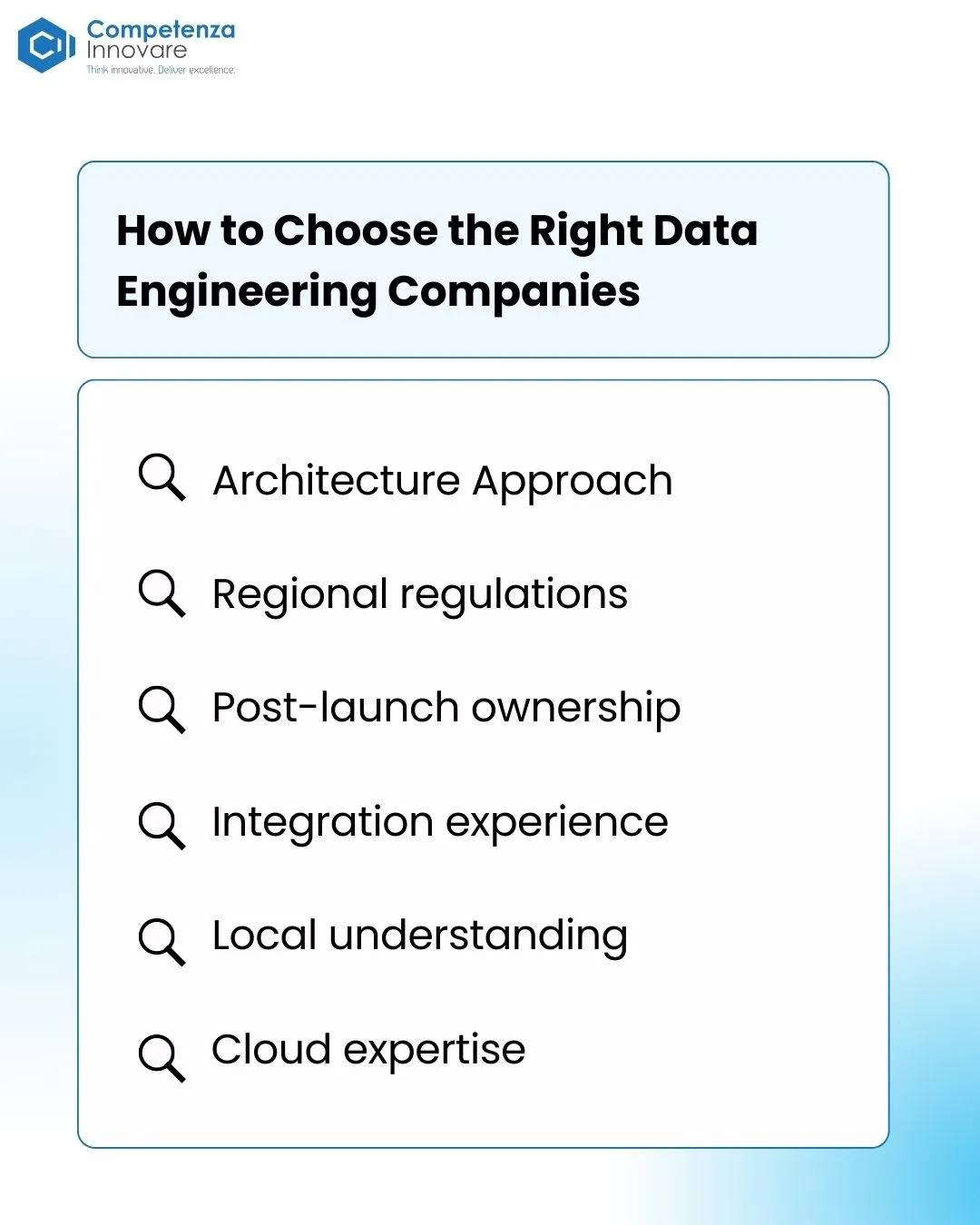
1. Architecture Approach
One of the first factors for evaluating any data engineering service provider is to see what they prioritize in their conversation with you. Whether it is platforms, technologies, pipelines, data lakes, and cloud names, or asking you about your current systems.
The right data engineering service provider will begin by assessing the integration between your ERP, CRM, warehouse, and other tools. Before suggesting any tools or solution they will ask about your performance bottlenecks.
2. Regional regulations
In a region like Saudi Arabia, where data governance is not optional, choose a vendor who has prior experience in working within the Saudi region and should be able to build a system with compliance in mind from day one.
3. Integration experience
Many organizations in Saudi Arabia operate in mixed environments that consist of modern as well as legacy systems. Some are built on global platforms, and others are built locally. The data engineering firm you are evaluating should be able to connect these systems cleanly and reliably.
4. Scalability planning
Another important factor that influences your data engineering firm selection is their scalability planning. Before finalizing the deal, make sure to confirm whether they build a flexible pipeline, or if they think about performance optimization.
5. Local understanding
One more very important factor that you should not miss out on is to confirm their understanding of the Saudi Arabia region and their familiarity with the Vision 2030 initiative. They should also be able to understand stakeholder dynamics, approval cycles, and cultural context.
6. Cloud expertise
And finally, the last and very important parameter you should not miss out on is to examine their cloud expertise beyond migration. Though many vendors can move clouds, not all of them can optimize performance, control costs, and design workload-efficient architecture. So it is better to ask about how they manage cost visibility, scaling policies, and storage optimization. This is important because poor cloud design led to unpredictable bills.
How Competenza Stands out
In the market where all the data engineering service providers position themselves around analytics, dashboard, or generic digital transformation, Competenza stands out by focusing on the engineering backbone first. They treat data engineering as a core infrastructure rather than a supporting service.
Competenza innovare approaches data engineering from the pipeline and platform layer. They emphasize designing structured ignition frameworks, scalable data models, orchestration logic, and governance control before analytics is layered on top. This reduces the risk of rebuilding the foundation later when data volume increases or AI initiatives expand.
Another fact that differentiates Competenza from the rest is that it embeds governance into its design approach. Instead of treating compliance, access control, and license as secondary concerns, they integrate these elements into pipeline architecture. This reduces operational risk and audit exposure in Saudi Arabia’s compliance-sensitive environment.
Competenza focuses on optimizing workloads, improving cost visibility, and designing scalable environments that can support analytics and AI without performance degradation.
And finally, Competenza treats data engineering as an evolving system that requires monitoring, optimization, and resilience planning. This approach supports stability over time, as organizations expand their systems, integrate new platforms, or adopt advanced analytics.

Conclusion
If your teams are still fixing reports at the last minute, questioning data accuracy, or struggling with unpredictable cloud costs, the issue is not analytics. It is the foundation underneath.
Good Data engineering determines how confidently your organisation can scale, innovate, and remain compliant. The partner you choose today will shape that stability for years. So look beyond surface-level claims. Ask how they design resilient pipelines, embed governance, and optimize cloud performance over time.
If you are evaluating data engineering companies in Saudi Arabia, choose a partner that approaches architecture with clarity and ownership. Competenza stands out by combining enterprise-grade data architecture with hands-on delivery, governance-aware design, and scalable cloud engineering.
Your data foundation should accelerate decisions, not create friction. Take the next step with a partner who builds for long-term stability, not short-term fixes.
FAQs
How Do We Know If Our Problem Is Really a Data Engineering Issue?
If you see conflicting reports, frequent ETL failures, slow data refresh cycles, AI initiatives stalling due to messy datasets, or rising cloud costs without clarity, the issue is likely architectural. These are signs of weak data foundations rather than analytics problems.
Won’t Cloud Migration Automatically Solve Our Data Problems?
Cloud migration changes infrastructure, not architecture. If data models, integration logic, or governance frameworks are poorly designed, those problems simply move to the cloud. Proper data engineering ensures the environment is scalable, cost-efficient, and structured.
How Do We Ensure Compliance and Data Security?
Compliance should be embedded in architectural design. This includes role-based access controls, data lineage tracking, encryption, and residency alignment. Ask how governance is implemented at the pipeline and storage level, not just documented in policy.
How Do We Ensure the Architecture Is Future-Proof?
Future-proofing comes from choosing scalable cloud-native frameworks, implementing clean data models, and embedding governance early. Ask the partner how the platform will handle increased data volume, additional integrations, and AI workloads in the next three to five years.