TL;DR
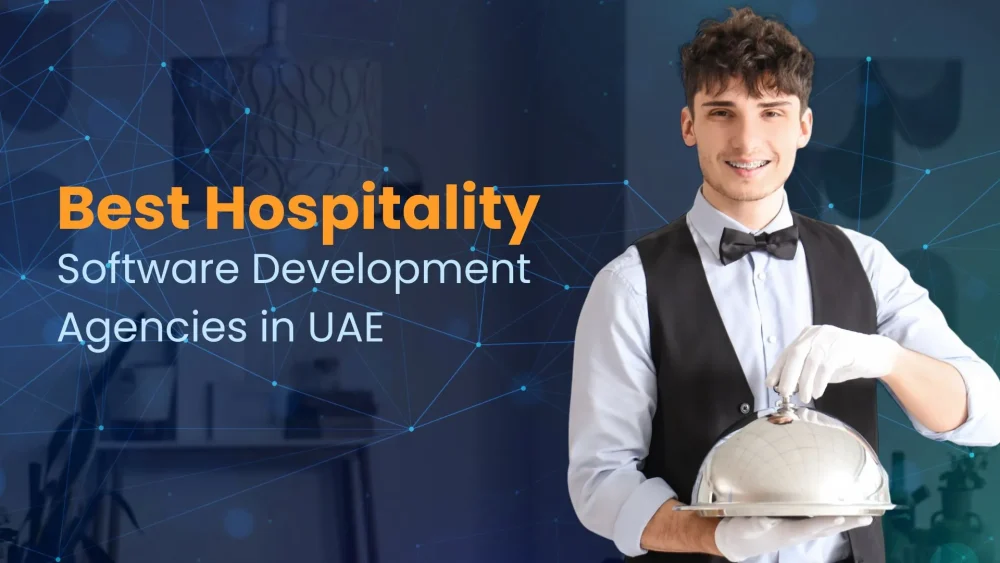
This guide compares the top hospitality software development agencies in the UAE, so you can avoid shortlisting the vendors that look identical at first glance. It helps you focus on what actually matters before making a commitment.
We have shortlisted these agencies based on:
- Architecture depth
- Hospitality workflow understanding
- Integration capability
- Multi-property scalability
- Governance and delivery structure
The table below helps you quickly identify which agency fits based on your exact requirements.

Introduction
Five tabs are open in your browser.
Five hospitality software development companies in the UAE, five polished websites that claim high scalability, integrations, and hospitality expertise.
And somehow they all sound the same. Though their case studies look impressive, the pitch deck sounds confident, pricing is within range, you still can’t decide who can actually deliver once your PMS is wired into daily operations.
Because once that system goes live, it touches everything: check-ins, billing, restaurant sync, and management reports. And if something breaks, it doesn’t stay technical. It becomes operational.
The challenge here is not finding the right options; it is to reduce risk & separating the noise from capability. This guide is written for that exact stage. We have listed some of the best Hospitality software development agencies in the UAE.
Before we discuss the best hospitality software development agencies in the UAE, it is important to understand why custom software matters so much in this industry.
Why UAE Hospitality Businesses Need Custom Software Development
Hospitality today is no longer about just check-ins and check-outs. And especially in Dubai, where a single property might be handling international guests, OTA integrations, multi-currency billing, F&B outlets, event bookings, loyalty programmes, and corporate events all at once, it has to be a world-class experience, every single time
Off-the-shelf systems rarely account for that level of operational complexity.
That’s where many hospitality leaders start exploring custom hospitality software development in the UAE, rather than forcing a generic platform to fit.
These are some of the common factors that influence your decision to choose custom software development for your hospitality business.
1. Multi-property operations
Many UAE hotel groups manage city hotels, beach resorts, serviced apartments, and branded restaurant chains. Though each falls under one portfolio, they run slightly differently. And when you run them on off-the-shelf software, the system quickly exposes the gaps. Whereas custom software development helps with
- Centralised reporting across properties
- Shared data governance rules
- Standardised executive dashboards
All this while still preserving property-level flexibility
This helps leadership with centralized visibility without disrupting local flexibility.
2. Need for integration
Modern hospitality systems are deeply connected.
A setup typically includes
- PMS software
- POS systems for restaurants
- OTA APIs
- Payment gateways
- Loyalty platforms
- Accounting software
- Housekeeping workflows
- Revenue management dashboards
These systems should communicate seamlessly with one another to improve workflow. If they don’t communicate, , teams end up reconciling the data manually. That may lead to errors, slow reporting, and increased operational friction.
With a custom software, you can integrate these systems tightly rather than relying on plugins that only partially sync data.
3. Higher Guest expectations
Guest now expect
- Mobile check-in
- Contactless payments
- Real-time booking confirmations
- Personalized offers
- Fast billing resolution
These are no longer differentiators; these are baseline expectations.
A small error or delay in check-in or billing is immediately felt by guests and often shows up in reviews. Behind a smooth stay, multiple tech systems have to work together: PMS, POS, OTAs, payments, and loyalty.
A flexible hotel management system that Dubai operators rely on needs to support both staff efficiency and guest experience. Custom software development helps align both under one connected system.
4. Growth expectations
Expectation for an international expansion is quite natural. You may want to expand your Dubai property in Saudi Arabia or Abu Dhabi. And that’s why your system should
- Support multi-property reporting
- Handle varying operational models
- Integrate new models without rebuilding
- Maintain performance under high occupancy
Off-the-shelf platforms can struggle when business models evolve. Custom hospitality software development in the UAE allows architecture to grow with the portfolio.
5. Long-term control and ownership
When your business depends on third-party vendor-controlled platforms, roadmap changes are often beyond your control.
With custom solutions
- Feature development can align with business strategy
- Integrations can be prioritized based on need
- Data ownership remains clearer
- Vendor lock-in risk is reduced
This level of control becomes valuable as the business grows.
Hotel software development in Dubai is more about alignment than just complexity.
All of these challenges point to one thing: hospitality software is not a single system; it is an ecosystem. So what does that ecosystem actually include? That’s what the section below explains.
If you want to read the benefits of custom software development in GCC, read this guide
Types of Hospitality software agencies can build
Modern hospitality operations are powered by multiple connected systems. In a typical hospitality software development engagement in the UAE, agencies build specialized software that manages reservations, F&B operations, reporting, guest experience, and multi-property control within a single integrated ecosystem.
Below is a simplified view of the core solutions typically delivered in hospitality software development projects in the UAE. Each system addresses a different operational layer.

Best hospitality software development agencies in the UAE

1. Competenza

Competenza builds operationally aligned custom software designed to scale with multi-property portfolios, not one-off digital products. They design a fully customized, integration-first system that aligns with real hospitality workflow. Unlike other agencies, they build the software from the ground up. That includes custom PMS software development, multi-property reporting layers, OTA integrations, F&B system connectivity, and guest experience applications, all under a unified architecture.
What differentiates Competenza is its approach: architecture before surface, integration depth before feature expansion, and operational workflow mapping before coding begins.
Why we shortlisted Competenza
We shortlisted Competenza for its architecture-first approach and its alignment of the system to operational workflows, not the other way around.
Best for: Competenza is best for multi-property hotel groups requiring centralized reporting, hotel brands requiring a custom guest experience platform, and restaurant groups needing back-end integration.
Not ideal for: Competenza may be less suitable for small-scale projects for small-scope projects such as a simple hotel website, and for projects that require only marketing site development without operational backend complexity.

2. Mirchandani

Mirchandani focuses on optimizing and implementing established enterprise systems for hospitality businesses, particularly ERP, finance, procurement, and operational management platforms.
Why we shortlisted Mirchandani
We shortlisted Mirchandani for their hospitality industry experience and focus on ERP and business system implementation.
Best for: Mirchandani is ideal for hospitality groups upgrading their finance, procurement, or HR platforms, businesses that prefer structured, vendor-backed solutions, and operators seeking to integrate existing enterprise tools.
Not ideal for: Mirchandani is less suitable for hospitality groups that need fully custom PMS software development or highly tailored multi-property architecture.
3. XByte

XByte is strongest in building revenue-generating web platforms, such as high-performing booking websites, online ordering systems, and e-commerce-driven hospitality portals.
Why we shortlisted XByte solutions
We shortlisted the XByte solution for its experience in building scalable web platforms that drive direct booking and online revenue.
Best for: XByte is best for hotels improving their direct booking websites, restaurant chains launching online ordering platforms, and hospitality brands focused on ecommerce style customer journeys.
Not ideal for: XByte is less suitable for hotels that need custom PMS software development or a multi-property operational architecture build.
4. Sisgain

Sisgain builds mobile apps and digital platforms for the hospitality and travel sector, including banking apps, travel portals, and customer-facing solutions. They specialize in building mobile apps and digital platforms rather than deep backend PMS architecture.
Why we shortlisted Sisagain?
We shortlisted Sisgain for their customer-facing mobile applications and digital platforms.
Best for: Sisgain is best for hotels wanting to launch mobile booking applications, travel agencies building reservation portals, and hospitality start-ups developing marketplace-style platforms.
Not ideal for: Sisgain is less suitable for hotels or travel partners that require PMS software development and a core hospital management system.
5. Codiant

Codiant sits between digital experience and platform development. They build broader digital ecosystems that include booking engines, CRM systems, loyalty platforms, and custom engagement tools.
Why we shortlisted Codiant?
We shortlisted Codiant for its dedicated travel and hospitality vertical expertise and its experience building booking systems, reservation engines, marketplace platforms, and mobile applications for guest engagement.
Best for: Codiant is best for hospitality brands digitizing the customer journey, developing loyalty programs, or building CRM or reservation applications.
Not ideal for: Codiant may be less suitable for businesses that require extensive backend system integration.
6. iSync Evolution

iSync Evolution positions itself as a technology solutions provider for travel and hospitality businesses, with a stronger emphasis on operational automation and system integration rather than purely on digital experience design. They build reservation systems, management platforms, and custom applications to improve backend workflows and process efficiency.
Why we shortlisted iSync Evolution?
We shortlisted iSync Evolution for their experience in support system integration and backend process improvement, as well as their capability to modernize internal hospitality operations.
Best for: iSync Evolution is best for mid-sized hotels digitizing internal processes, hospitality businesses automating manual workflows, and organizations that need tailored operational tools, without large-scale enterprise rebuilds.
Not ideal for: iSync Evolution is not suitable for hotels building core infrastructure at scale, or hotels requiring a strong UAE-specific consulting presence and governance-heavy delivery.
7. SoftTeco

SoftTeco positions itself as a full-cycle custom development company delivering both operational systems and customer-facing platforms under one roof. They build solutions such as property management systems, booking engines, loyalty platforms, and CRM-integrated tools that combine backend automation with guest experience functionality.
Why we shortlisted Softteco
We shortlisted SoftTeco for their broad suite of hospitality-oriented systems, including property management, booking engines, and CRM solutions.
Best for: SoftTeco is ideal for hospitality businesses needing fully customized booking and reservation platforms, and for hotels and resorts that want bespoke property management systems integrated with CRM and payment solutions.
Not ideal for: SoftTeco may be less suitable for hotels that require UAE-based strategic partners with a strong local regulatory and market advisory presence, or for hotels seeking a deep architectural overhaul of core hotel operations.
Each of these agencies brings different strengths to the table. The real question now is not who is good, but who is right for your operational model. Before making that decision, here is what you should evaluate carefully.
How to choose the right hospitality software development agency
1. Operational understanding
Hospitality is not another software category; it is workflow-driven, time-sensitive, and guest-facing at every layer. A capable development partner should understand how hospitality operations work before writing a single line of code.
This includes
- Check-in and check-out logic: peak hour handling, early arrivals, late departures, deposit management
- Room allocation rules: availability mapping, upgrades, maintenance blocks, group bookings
- OTA syncing challenges: rate parity, inventory updates, cancellation policies, and real-time availability
- F&B billing flows: posting restaurant charges to rooms, split billing, outlet-level booking
The partner you consider should be able to speak the language of occupancy rates, RevPAR, housekeeping status, and POS reconciliation.
Considering this factor will help you distinguish between a technically capable agency and a partner who truly understands how the hospitality business operates.
2. Architecture and integration depth
Hospitality technology does not operate in isolation. Even a mid-sized hotel in Dubai may run six to ten interconnected systems every day. Before finalizing a hotel software development Dubai partner, you should
- Check how they structure the integration layer,
- Handle real-time data synchronization, and
- Ensure data consistency across properties.
Some vendors heavily rely on plug-ins and patchwork connectors. This approach works for now, but it creates fragility as the ecosystem scales .
Stronger partners design an API first, a modular architecture, which means
- Clean data flow between systems
- Easier upgrades
- Lower dependency on brittle connectors
- Scalable infrastructure for multi-property expansion
This helps you design a system that holds up under real-world pressure.
3. Multi-property scalability
In the UAE hospitality market, where growth is rarely static, expansion is quite common. For example, a hotel group operating in Dubai today may expand to Abu Dhabi, or even to KSA in a few years.
The system you choose today should not limit expansion later.
Your hospitality platform should support
- Centralized dashboard for group-level activity
- Property-level configuration flexibility for pricing, approval, and workflow
- Consolidated financial reporting across locations
- Role-based access control to manage permissions across properties
Therefore, ask the vendor who you are considering
- How will the data model handle the multiple properties?
- Can each property customize the workflow independently?
- Is reporting consolidated by design or manually aggregated?
- How does user access work across locations?
This consideration helps you reduce reimplementation risk, maintain reporting integrity, and balance control and flexibility.
4. Governance and delivery transparency
Unlike internal tools, hospitality systems affect daily operations. If the timeline slips or requirements are misunderstood, the impact is visible at the front desk, in billing cycles, and in management reporting.
And that’s why, before finalizing the vendor, get clarity about
- How will sprints be structured?
- How often will progress be reviewed?
- Who will be accountable for delays? and
- What happens if the scope is delayed?
Without structured governance, projects drift, communication gaps widen, and scope expands widely.
This factor will help you control the budget, strengthen internal justification, and minimize operational disruption.
5. Data ownership and compliance awareness
Guest data is one of the most valuable assets in hospitality. Every reservation, passport detail, payment record, loyalty profile, and stay history sits inside your system. A breach or compliance failure is not only a technical issue but also a breach of trust.
That’s why, before finalizing the vendor, get clarity on
- Where is the data hosted?
- Who legally owns the data?
- How are backups managed?
- How is access controlled?
Make sure the vendor treats governance and compliance as the centre of conversation, not as secondary.
This will help you protect your brand reputation, reduce legal exposure, and prevent vendor lock-in.
How Competenza stands out
Many agencies can build hospitality software, but only a few can build systems that quietly hold systems together during peak season or scaling.
The reason Competenza stands out for building hospitality software is its approach to treating hospitality technology as long-term infrastructure, not just a development project.
Some of the important characteristics that help competenza stand out are
1. They design around how hotels actually operate
Instead of forcing hotels to adapt to rigid software logic, Competenza aligns systems with real hospitality workflows, such as room allocation, F&B billing sync, OTA integrations, and multi-property reporting structures.
This benefits customers because the final system fits naturally into daily operations, reducing friction from staff training and minimizing post-launch disruption.
2. Strong Integration depth
Competenza emphasizes API-driven architecture and stable system integration rather than relying on fragile plug-ins. Their builds are designed to integrate PMS, POS, booking engines, payment gateways, loyalty systems, and reporting dashboards into a single, structured ecosystem.
This benefits hospitality operators by improving data accuracy, reducing manual reconciliation, and maintaining system stability during high-occupancy periods.
3. Governance and delivery discipline
Competenza emphasizes API-driven architecture and stable system integration rather than relying on fragile plug-ins. Their builds are designed to integrate PMS, POS, booking engines, payment gateways, loyalty systems, and reporting dashboards into a single, structured ecosystem.
This benefits hospitality operators by improving data accuracy, reducing manual reconciliation, and maintaining system stability during high-occupancy periods.
4. Architecture first, not a feature list
Competenza begins with system architecture before moving into feature development. They map workflows, define integration layers, and design scalable data structures before writing code. This helps businesses reduce future rework, prevent system bottlenecks, and ensure the platform scales smoothly as new properties or modules are added.
5. Long-term partnership approach
Rather than treating projects as one-time deliveries, Competenza works as an ongoing engineering partner, supporting upgrades, integrations, and system evolutions as the hospitality portfolio grows.
This helps businesses protect their long-term technology investments and ensures the systems continue to support expansion without requiring complete redevelopment.
Conclusion
You already know you need the right hospitality software partner. The real question is whether you are choosing with enough clarity.
Revisit your pain points. Challenge assumptions. Ask harder questions about architecture, integration depth, governance, and long-term scalability. Do not rush just because a proposal looks polished.
If you want a structured, architecture-first discussion before committing, speak with Competenza. A focused technical conversation can help you identify potential risks and design a system that actually supports your operations.
In hospitality, the best decisions are those that remove friction before your guests even notice it.
FAQs
How do we assess integration strength before the system is built?
Integration failures are the most common source of post-launch frustration.
Instead of asking “Can you integrate with X?”, ask:
- How will you structure the API layer?
- Is integration real-time or batch-based?
- How do you handle sync failure?
- How do you prevent duplicate or inconsistent records?
Request architecture diagrams, not just feature lists. If the vendor cannot clearly explain their data flow, the risk increases significantly.
What happens if we expand to multiple properties after launch?
This is where many systems quietly fail.
Ask:
- Is the data model multi-property by design?
- Can we configure each property independently?
- Is reporting centralised automatically?
- Will adding properties require a rebuild?
If scalability is not considered in architectural planning, expansion becomes a separate project rather than a smooth extension.
How do we prevent vendor lock-in with custom development?
Custom software should increase control, not reduce it.
Clarify:
- Who owns the source code?
- Who owns the database?
- Is documentation provided?
- Can another team maintain the system if needed?
True custom development gives you architectural control. Weak contracts create dependency.
How do we evaluate post-launch accountability?
Many vendors perform strongly during sales and development, but disappear after deployment.
Ask:
- What does support look like during peak season?
- Is there a defined SLA?
- How are upgrades handled?
- Is there a roadmap discussion post-launch?
Hospitality systems evolve. A reliable partner treats go-live as phase one, not the finish line.